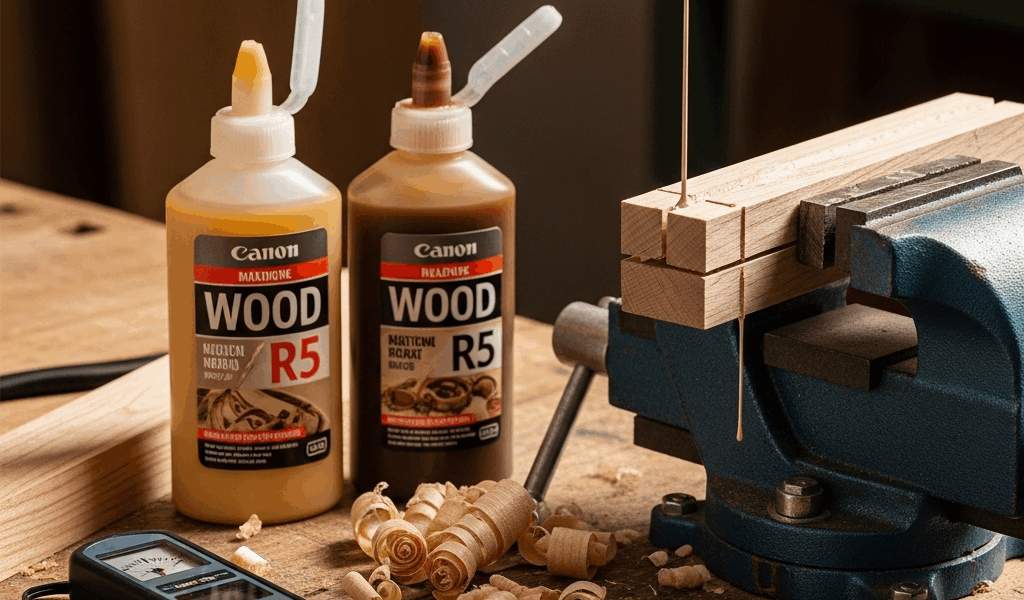
Titebond III and standard Gorilla Wood Glue are both water-based wood adhesives, but they are not equivalent. Titebond III passes the more demanding ANSI/HPVA Type I water-resistance test, has an 8–10 minute listed open time, and can be applied at lower temperatures. Standard Gorilla Wood Glue passes Type II, lists 20–30 minutes of clamp time, and is intended for indoor or covered outdoor woodworking.
The most important correction is that Gorilla Wood Glue is a PVA adhesive. It is not the foaming polyurethane product sold as Original Gorilla Glue. Confusing those two Gorilla products leads to incorrect advice about moisture activation, expansion, cleanup, gap filling, and food-contact use.
Titebond III vs Gorilla Wood Glue: Quick Comparison
| Feature | Titebond III Ultimate | Gorilla Wood Glue |
|---|---|---|
| Adhesive type | Water-based proprietary wood-glue formulation | Water-based PVA wood glue |
| Water-resistance standard | ANSI/HPVA Type I | ANSI/HPVA Type II |
| Manufacturer positioning | Interior and exterior woodworking | Indoor and covered outdoor woodworking; not continual water exposure |
| Open assembly time | 8–10 minutes in listed test conditions | Follow current label; assembly time varies with conditions |
| Clamp guidance | Generally 30–60 minutes for unstressed joints; longer for stressed joints | 20–30 minutes at room temperature |
| Full cure / stressing | Do not stress a new joint for at least 24 hours | Fully cured in 24 hours |
| Minimum listed application temperature | Approximately 47°F | 55°F |
| Indirect food contact | Manufacturer states FDA compliant | Manufacturer states compliant once cured |
| Expansion | No foaming expansion | No foaming expansion |
| Cleanup while wet | Water | Water |
These values are manufacturer specifications, not guarantees for every joint. Wood species, moisture content, fit, surface preparation, temperature, humidity, glue spread, clamp pressure, and load all affect the result.
The Naming Trap: Gorilla Wood Glue Is Not Original Gorilla Glue
Standard Gorilla Wood Glue is a PVA adhesive. It does not require dampening, does not foam, and does not expand while curing. Gorilla says it passes Type II water resistance and is not recommended for continual water exposure.
Original Gorilla Glue is a moisture-activated polyurethane adhesive. The manufacturer directs users to dampen a surface, apply a thin layer, and expect expansion. Gorilla explicitly states that even though the polyurethane expands, it is not a gap-filling product. Foam occupying an empty space does not create a well-fitted structural joint.
For a meaningful comparison, check the exact bottle name. “Titebond III vs Gorilla Glue” can refer to at least three different products: standard Gorilla Wood Glue, Gorilla Wood Glue Ultimate, or Original Gorilla Glue.
Water Resistance: Type I vs Type II
Titebond III Ultimate passes ANSI/HPVA Type I water resistance. Standard Gorilla Wood Glue passes Type II. Type I is the more severe test and is the better match when a properly designed wood joint may see exterior moisture.
“Waterproof” does not make the entire project waterproof or suitable for continuous submersion. Wood movement, end-grain sealing, joinery design, fasteners, drainage, finish maintenance, and exposure remain critical. Neither product should be substituted for an adhesive specified for structural construction, below-waterline use, or another regulated application.
For indoor furniture, cabinets, boxes, and shop fixtures, both products can provide adequate moisture resistance when used according to their instructions. Titebond III’s Type I rating becomes more relevant for exterior or frequently wet service.
Open Time, Clamp Time, and Cure
Titebond lists an 8–10 minute open time for Titebond III under specified laboratory conditions. Gorilla Wood Glue lists 20–30 minutes of clamping at room temperature and a 24-hour full cure. Titebond’s general guidance recommends 30–60 minutes of clamping for an unstressed joint and 24 hours for a stressed joint, with no stress on the new joint for at least 24 hours.
Open time is not the same as clamp time. Open time describes how long the spread adhesive remains workable before joining. Clamp time describes how long the assembled joint stays under pressure. Full cure describes later adhesive development. Do not use one manufacturer’s time for the other product.
Prepare every part and dry-fit the assembly before spreading glue. Large assemblies may exceed the available working time even when the glue is advertised as “extended.” Use subassemblies or a product with a deliberately longer working time when needed.
Temperature and Shop Conditions
Titebond lists Titebond III for application down to approximately 47°F. Gorilla lists standard Gorilla Wood Glue for 55–75°F, best at room temperature. That does not mean cold makes one cure faster. Low temperatures can impair adhesive film formation, increase viscosity, and delay strength development.
Condition the adhesive, wood, and workspace within the current label requirements. Avoid gluing frozen, wet, dusty, burnished, oily, or contaminated surfaces. If a shop is near the minimum temperature, keep the assembly within the required range throughout clamping and cure.
Joint Fit and “Gap Filling”
Both Titebond III and Gorilla Wood Glue are intended for well-fitted wood joints. Applying more glue does not compensate for a loose mortise, poorly cut tenon, rounded edge, or missing wood. Excessively thick adhesive lines can perform differently from the thin, evenly clamped bonds used in manufacturer testing.
Original Gorilla Glue expands, but Gorilla’s own technical information labels its gap-filling capability “No.” If a joint has a meaningful gap, remake the part, add a properly fitted patch, or select a repair system whose manufacturer explicitly approves the gap and load.
Food-Contact Projects
Titebond states that Titebond III complies with FDA requirements for indirect food contact and identifies cutting boards as an application. Gorilla states that cured Gorilla Wood Glue complies with 21 CFR 175.105 for indirect food contact and can be used for projects such as salad bowls and cutting boards.
That does not mean wet glue is food-safe, nor does it approve direct food packaging, high-temperature service, or every finish. Allow the adhesive to cure fully and follow current product and finish instructions. Replace deeply cracked cutting boards that cannot be cleaned reliably.
Color, Cleanup, and Finishing
Titebond III dries light brown or tan. Standard Gorilla Wood Glue dries a natural tan wood color. Neither should be relied on as an invisible filler. Glue left on the surface can prevent stain from penetrating evenly.
Remove squeeze-out using the manufacturer’s recommended method. For visible work, many woodworkers allow a bead to become rubbery and then remove it carefully, or wipe while wet and later sand thoroughly. Test the process on scrap because wiping can spread diluted adhesive into surrounding grain.
Which One Should You Choose?
Choose Titebond III when:
- You specifically need a Type I water-resistance rating.
- The project is designed for exterior exposure.
- The shop or materials may be between about 47°F and 55°F.
- You want the manufacturer’s documented 8–10 minute open time.
Choose standard Gorilla Wood Glue when:
- Type II water resistance is appropriate for the project.
- The work is indoors or outdoors under cover rather than continuously wet.
- You prefer its natural-tan bond line and 20–30 minute listed clamp time.
- It is readily available and you can follow the 55°F minimum application guidance.
For most well-fitted indoor furniture joints, product choice matters less than correct preparation, glue spread, clamping, temperature, and cure. For exterior moisture exposure, Titebond III has the clearer specification advantage over standard Gorilla Wood Glue.
Application Checklist
- Confirm the exact glue product and current label.
- Dry-fit the complete assembly.
- Prepare clean, sound, properly fitted wood surfaces.
- Keep the glue, wood, and air above the specified application temperature.
- Spread a continuous, appropriate film and assemble within the open time.
- Apply enough clamp pressure for contact and a fine bead of squeeze-out without distorting the parts.
- Keep the joint clamped for the product- and joint-specific time.
- Allow the full cure before machining, loading, washing, or exterior exposure.
Frequently Asked Questions
Is Gorilla Wood Glue polyurethane?
No. The product named Gorilla Wood Glue is PVA. Original Gorilla Glue is the moisture-activated polyurethane product.
Does Gorilla Wood Glue expand?
No. Gorilla lists standard Wood Glue as non-expanding. Original Gorilla Glue expands during cure.
Is Titebond III waterproof?
It passes ANSI/HPVA Type I water resistance and is marketed as waterproof. That rating does not make a wood project suitable for continuous submersion or excuse poor exterior design.
Which glue is better for cutting boards?
Both manufacturers state that the cured products covered here comply with indirect-food-contact requirements. Titebond III additionally carries Type I water resistance. Follow the current label and allow a complete cure.
Can either glue repair a loose joint by filling the gap?
Do not rely on either product to replace sound joinery. Refit or rebuild the joint, or use a repair adhesive specifically approved for the actual gap and load.
Specifications were checked against current manufacturer information in August 2026. Always follow the label and technical data for the exact bottle you purchase.

Stay in the loop
Get the latest master wood crafters updates delivered to your inbox.