Best Wood Glue for Table Joints — Why Joint Type Matters More Than Brand
Wood glue selection has gotten complicated with all the marketing noise flying around. I spent two years rebuilding vintage furniture and watching modern tables fail in predictable ways before I understood what was actually happening: the glue choice depends entirely on the joint’s role in the structure.
A mortise-and-tenon joint in a table leg carries different stresses than an edge-glued tabletop, which carries different stresses than an apron-to-leg connection. Each demands a specific glue personality—gap-filling capacity, cure speed, creep resistance, or shear strength. Most woodworking blogs rank glues generically. That’s useless for tables.
Mortise-and-Tenon Joints Need Glue That Handles Movement
This joint is structurally elegant and structurally demanding. The mortise (rectangular hole) accepts the tenon (projecting arm), and once glued, they lock together under compression and shear. But here’s the problem: wood moves. Grain runs one direction along the leg and another direction perpendicular in the apron. Seasonal humidity swings cause expansion and contraction at different rates in different directions.
A glue that’s too brittle—epoxy, for instance—will fracture as the wood moves around it. I opened a 1960s walnut table once that had failed at every mortise-and-tenon joint; the previous owner had glued it with epoxy and the joints had simply snapped under normal seasonal movement. That was the moment I stopped trusting epoxy for any wood-to-wood joint.
Three glues excel here for different reasons:
- Hide glue (animal-based, liquid or granules) — Reversible, gap-filling, and extremely flexible once cured. It handles wood movement beautifully. Clamp time is 24 hours, full cure runs 2–3 weeks. Moisture tolerance is poor (it can rehydrate), so indoor use only. Cost per joint runs $0.50–$1.50. The real advantage: if you ever need to repair the joint, you can reheat and separate it without destroying the wood.
- Polyurethane (Gorilla Glue, Titebond Polyurethane) — Gap-filling, waterproof, extremely strong. Clamp time 30 minutes minimum, full cure 24 hours. It requires moisture to activate—dampening one surface before assembly—and it expands slightly during cure, which helps fill voids. Cost per joint is $0.30–$0.80. The catch: over-clamp and you’ll force out all the glue and starve the joint. This matters more than you’d think.
- Titebond III Premium Wood Glue (yellow, PVA-based) — Not as gap-filling as hide glue, but faster. Clamp time 30 minutes, full cure 24 hours. Moisture-resistant (exterior-rated), so it handles humidity in kitchens without sweating. Cost per joint is $0.20–$0.50. It won’t handle wood movement quite as forgivingly as hide glue, but it’s reliable for indoor furniture and doesn’t require the fussing around that polyurethane does.
Skip epoxy. It’s brittle, overkill for a wood-to-wood joint, and your tenon will eventually fail in shear because the glue can’t flex. That’s a structural mistake wearing an expensive label.
For mortise-and-tenon work, I reach for hide glue on heirloom pieces where repairability matters, and Titebond III on modern tables where speed and simplicity are the goal.
Edge-Glued Table Tops Need Glue That Won’t Creep
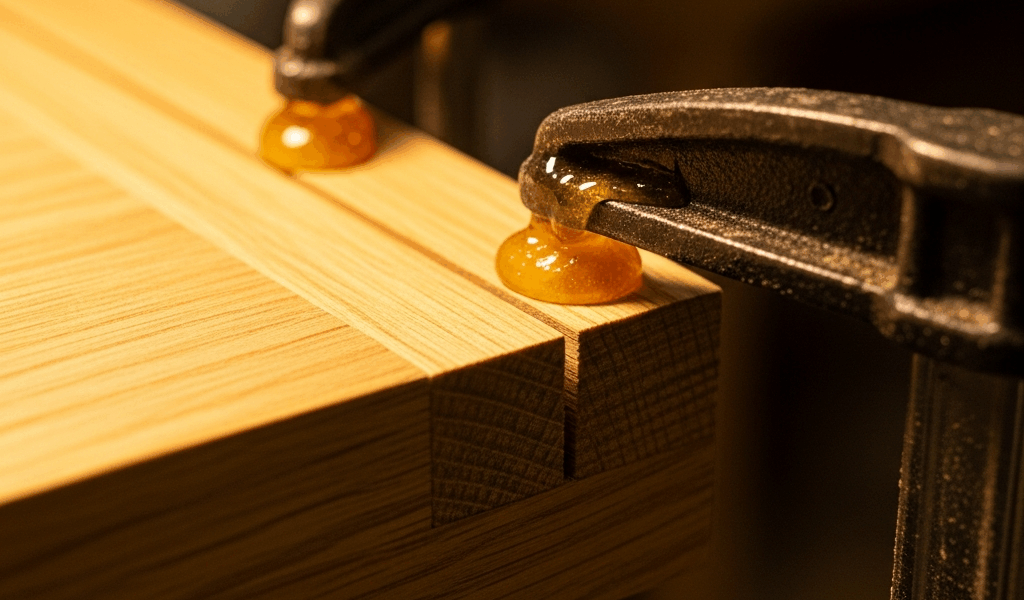
An edge-glued top is two or more boards clamped edge-to-edge to form a wider panel. The glue line runs perpendicular to the grain in both boards. This joint fails not by breaking but by creeping—the glue film gradually yields under clamping pressure and seasonal wood movement, allowing the boards to shift microscopically. Over five years, you can see light between the boards. That’s the disaster you’re trying to prevent.
Clamping pressure matters enormously here. Standard practice is one clamp per 12 inches of joint length, spaced on alternating sides, applying 100–150 PSI. Most woodworkers underclamp. I’ve seen tabletops with clamps spaced 24 inches apart; those joints failed within three years because the pressure was just too light.
Yellow glue (Titebond or Elmer’s Carpenter’s Wood Glue) is the baseline. It creeps modestly under consistent load and humidity cycling. Full strength is 24 hours, but creep can still occur afterward. Cost per linear foot is roughly $0.08–$0.15. You won’t need fancy gear—just clamps and patience.
Polyurethane resists creep better. It doesn’t set purely through moisture evaporation like PVA glues; it cures through a chemical reaction, creating a denser glue line. Over five years of humidity cycling, polyurethane-glued edge joints show less movement. Clamp time is 30 minutes, full cure is 24 hours. Cost is $0.15–$0.35 per linear foot. The downside: you must dampen one surface before assembly, and squeeze-out is messier to clean up afterward.
Hide glue performs exceptionally well here because it doesn’t creep under sustained load the way synthetic glues do. That’s because of its protein structure—something I won’t bore you with. Clamp time is 4–6 hours, full cure is 2–3 weeks. If your timeline allows, hide glue is the gold standard for edge joints on fine furniture. Cost per linear foot is $0.30–$0.60.
Grain direction matters too. Gluing long-grain to long-grain (the ideal case) — any of these glues will perform. Include edge grain (a less ideal scenario), and polyurethane’s gap-filling ability gives it the edge.
Apron-to-Leg Connections Demand High Shear Strength
The apron is the horizontal board connecting the legs. Under load—someone leaning on the table, or the table rocking slightly—the apron experiences shear stress. The glue joint must resist sideways slipping. Fail here and the entire table wobbles or racks (the frame becomes a parallelogram instead of a rectangle).
This is where glue strength development speed becomes critical. You can’t clamp an apron-to-leg joint for three weeks; you need the joint functional within 24 hours so you can flip the table and work on the next side.
Polyurethane is the fastest full-strength option. It develops 90% strength in 24 hours, full structural strength in 24–48 hours. Clamp time is 30 minutes minimum, but many builders clamp for 2–4 hours just to feel confident. Shear strength is excellent—roughly 3,600 PSI. Cost per joint is $0.30–$0.70.
Titebond III reaches full strength in 24 hours, with shear strength around 3,500 PSI. It’s marginally weaker than polyurethane but far simpler to use (no dampening required, less squeeze-out). Clamp time is 30 minutes. Cost per joint is $0.20–$0.50.
Hide glue develops strength slowly. Full strength takes 2–3 weeks, and intermediate strength at 24 hours is only 60–70% of final strength. You can work around this by slow-curing the assembly (no high stress for the first week), but it’s not practical for production tables where you need to move on to the next one.
Pre-gluing prep matters here. Mortise-and-tenon apron joints should be dry-fit first (no glue) to ensure the tenon slides fully home. If it binds, you’ll starve the joint by not being able to close the gap completely. Wood moisture content should be 6–12% — use a cheap moisture meter ($25–$40). Green wood (freshly milled) won’t accept glue reliably and will move dramatically as it dries, rupturing the joint.
Glue Comparison Table by Joint Type
| Joint Type | Best Glue | Clamp Time | Full Cure | Key Strength |
|---|---|---|---|---|
| Mortise-and-Tenon | Hide Glue | 24 hours | 2–3 weeks | Flexibility, reversible |
| Edge-to-Edge Top | Polyurethane | 30 min | 24 hours | Creep resistance |
| Apron-to-Leg | Polyurethane | 30 min | 24 hours | Fast strength, shear |
| Mortise-and-Tenon (fast) | Titebond III | 30 min | 24 hours | Simplicity, moisture OK |
One Mistake That Ruins Table Joints
Over-clamping polyurethane is the single most common error I’ve watched destroy otherwise good joints. Probably should have opened with this section, honestly.
Polyurethane requires moisture to cure. You dampen one mating surface, clamp the joint, and the glue expands slightly—maybe 10–15%—as it reacts. If you clamp it like you would yellow glue (maximum pressure, the whole project), you force out all the expanded glue from the joint. The result is a starved joint: thin glue line, minimal adhesion, joint that fails under stress within months.
The fix: clamp polyurethane to light pressure. One clamp per 12 inches of joint length, tightened just past “snug.” Let the expansion do the work. You’ll see glue squeeze-out, which is exactly what you want—it means glue is actually in the joint. If you see no squeeze-out, you’ve clamped too hard.
I learned this the hard way building a cherry credenza five years ago. Used Gorilla Glue on the apron-to-leg joints and clamped it like I would yellow glue—tight, really tight. The table felt solid for two weeks, then I moved it and heard a cracking sound. When I disassembled it, the tenons had zero adhesion; they just fell out. The glue line was a paper-thin ghost of what it should have been. I re-glued everything with hide glue — much slower process — and it’s been solid ever since. Don’t make my mistake.
The second-most-common mistake: using water-based glue on wood with high moisture content. If your lumber hasn’t acclimated to your shop environment (6–12% moisture), the glue won’t penetrate properly and the joint will fail in shear. Let wood rest 2–4 weeks after milling, and measure moisture content before gluing. That $35 moisture meter is the cheapest insurance you’ll ever buy.


Stay in the loop
Get the latest master wood crafters updates delivered to your inbox.