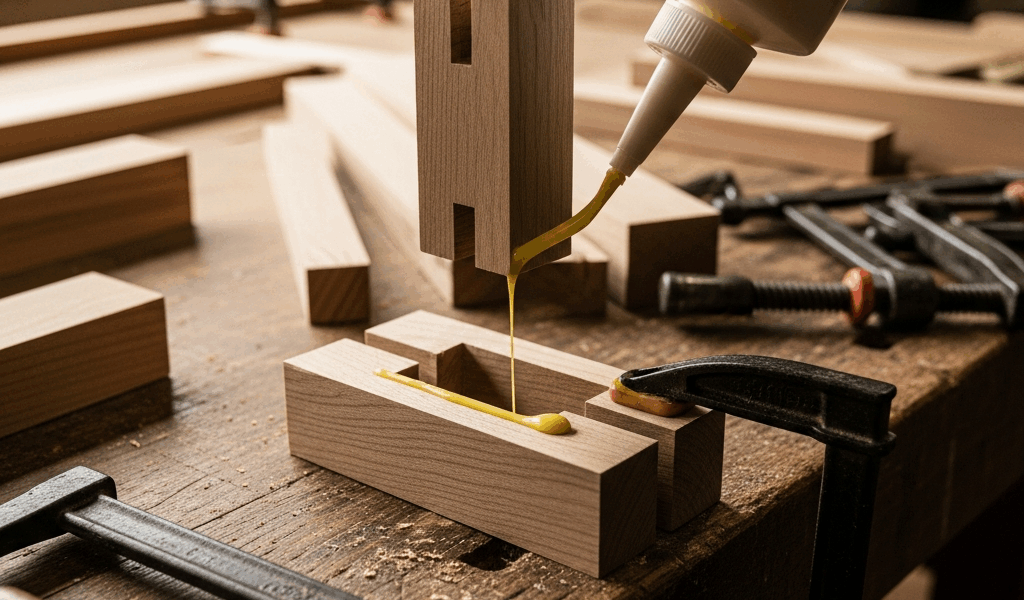
The best wood glue depends on the joint, the materials, moisture exposure, working time, and whether the parts fit closely. For most well-fitted indoor furniture joints, a quality PVA wood glue is the practical starting point. Exterior exposure, loose repairs, mixed materials, veneer work, and reversible restoration each call for a different decision.
This guide sorts adhesive types by job instead of naming one bottle as universally “strongest.” Product specifications below are manufacturer claims; joint design, surface preparation, temperature, moisture, clamping, and cure time still determine the result.
Quick Wood-Glue Selection Guide
| Project condition | Adhesive type to consider | Why | Main limitation |
|---|---|---|---|
| Indoor furniture and cabinets with close-fitting joints | Interior PVA wood glue | Easy application, water cleanup while wet, and a rigid bond line | Not the right choice for continual wet exposure or large gaps |
| Outdoor furniture or joints that may get wet | Type I water-resistant PVA, where the label permits the use | More demanding water-resistance classification than Type II | “Waterproof” adhesive does not make the wood or project suitable for submersion |
| Complex assembly needing more working time | Extended-open-time PVA or a suitable slow epoxy | More time to spread, assemble, align, and clamp | Longer fixture and cure schedules |
| Loose repair or a joint with missing material | Properly thickened structural epoxy, after diagnosing the joint | Can be formulated for gap filling | Mixing accuracy, surface preparation, cure temperature, and safety matter |
| Wood joined to some nonporous materials | Epoxy or polyurethane adhesive specified for both substrates | PVA is primarily intended for porous wood-to-wood joints | Compatibility varies; test and follow the current label |
| Veneer | Adhesive chosen for veneer type and pressing method | Open time, bleed-through, creep, and even pressure become central | A general furniture-glue rule is too broad |
| Traditional or reversible restoration | Appropriate hot or liquid hide glue | May support repair and reversibility goals | Technique, heat, moisture, and service conditions require care |
Best General-Purpose Choice: PVA for Well-Fitted Wood Joints
PVA wood glue is the sensible default for edge joints, mortise-and-tenon joints, dowels, dovetails, drawer boxes, cabinets, and many other indoor assemblies made from clean, dry wood. It spreads easily, needs no two-part mixing, and normally cleans up with water before curing.
The key phrase is well-fitted. PVA performs best as a thin, continuous film between mating surfaces. It should not be treated as putty for a loose tenon, a rounded shoulder, or missing wood. Fix the fit or choose a repair method designed for the actual gap.
For an indoor project that will remain dry, an interior PVA such as Titebond Original may be sufficient. When occasional moisture is plausible, compare the manufacturer’s Type II and Type I products. Our Titebond Original vs II vs III guide separates those use cases.
Best for Exterior Moisture: Match the Water-Resistance Standard
Titebond III is listed by its manufacturer as passing the ANSI/HPVA Type I water-resistance test. Standard Gorilla Wood Glue is listed as passing Type II. Type I is the more demanding classification and is the clearer choice of those two when a properly designed wood joint may face exterior moisture.
That classification is not permission to ignore drainage, movement, finish maintenance, end-grain sealing, fasteners, or rot-resistant material selection. It also does not mean every glued project can remain submerged. Follow the current product label and design the entire assembly for its exposure.
Do not confuse standard Gorilla Wood Glue, which is a PVA, with Original Gorilla Glue, which is a moisture-cured polyurethane adhesive that foams as it cures. See our focused Titebond III vs Gorilla Wood Glue comparison before choosing between the two PVA products.
Best for Gaps and Structural Repairs: Diagnose Before Reaching for Epoxy
Two-part epoxy can bond wood and, when combined with a filler approved by its manufacturer, can be formulated for some gap-filling and repair work. This makes it useful when a sound repair cannot be restored to a close-fitting PVA joint or when the adhesive must bond compatible dissimilar materials.
Epoxy is not a substitute for damaged fibers, rotten wood, poor geometry, or an overloaded joint. Remove failed adhesive and contamination, repair or replace unsound material, and choose the resin, hardener, filler, mix ratio, temperature range, and cure schedule as one system. WEST SYSTEM’s official epoxy bonding guidance distinguishes primary bonding, secondary bonding, and gap filling.
For a failed chair, table, or cabinet joint, start with our wood-joint repair guide. A cosmetic crack and a load-bearing structural failure should not receive the same treatment.
Best for Long or Complicated Glue-Ups
Open time is the period in which spread adhesive remains workable before assembly; clamp time is how long the joined parts remain under pressure; full cure is later. These are not interchangeable.
For a large cabinet, many mortises, a bent lamination, or a complex frame, rehearse the assembly dry. If the standard PVA’s listed open time is too short, use an extended-open-time product or another adhesive system explicitly suited to the job. Do not add water or improvised chemicals to change a glue’s working time unless the manufacturer permits it.
Special Cases That Need Their Own Choice
Veneer
Veneer introduces different concerns: uniform pressure, substrate flatness, glue bleed-through, moisture, open time, and long-term creep. Read our veneer-glue guide rather than applying a blanket furniture-joint recommendation.
Hardwood and oily species
Dense or naturally oily woods may require fresh machining, solvent or surface preparation allowed by the adhesive maker, and a bonding test using project offcuts. Our hardwood-joint glue guide covers the decision without assuming every species behaves alike.
End grain
End-grain-only butt joints are usually weak because the joint geometry offers little long-grain bonding area. Adhesive choice cannot rescue poor structural design. Add joinery where the load demands it, and see why end-grain glue joints fail.
Tables and other stressed furniture
A tabletop edge joint, an apron-to-leg joint, and a loose chair rung carry different loads. The table-joint glue guide explains why joint design and wood movement matter as much as the bottle.
How to Make a Wood-Glue Joint Succeed
- Read the current technical sheet and label. Confirm substrates, exposure, minimum application temperature, open time, clamp guidance, full cure, cleanup, and safety.
- Dry-fit first. The joint should close fully without using clamps to force badly cut parts into alignment.
- Use clean, sound surfaces. Remove old adhesive, dust, oil, finish, char, and damaged fibers using a method compatible with the wood and adhesive.
- Spread a continuous film. Coat the intended bonding area and assemble within the listed working time.
- Apply appropriate pressure. Aim for full contact without starving the joint or distorting the assembly. Clamp requirements vary by species, joint, and product.
- Respect temperature and cure time. A joint that feels firm may not be ready for machining, stress, water, or service.
- Test unfamiliar combinations. Use representative offcuts, especially with oily wood, old finishes, treated lumber, composites, or mixed materials.
Common Wood-Glue Mistakes
- Choosing by a “strongest glue” claim instead of the joint and service environment.
- Using PVA as a structural gap filler.
- Assuming “waterproof” adhesive makes the whole project waterproof or submersible.
- Confusing open time, clamp time, and full cure.
- Applying glue over finish, dust, oil, or old failed adhesive.
- Overtightening clamps until the parts bow or nearly all adhesive is forced out.
- Loading, sanding, machining, or wetting a joint before the stated cure schedule.
Wood-Glue Safety
Read the product label and safety data sheet before use. Wear the personal protective equipment the manufacturer specifies, provide required ventilation, avoid skin and eye exposure, and keep adhesives away from children. Epoxy systems and polyurethane adhesives have different hazards from water-based PVA. Do not rely on a product family’s reputation; follow the documents for the exact resin, hardener, filler, or adhesive in your hand.
Bottom Line
For clean, close-fitting indoor wood joints, start with a reputable PVA that matches the project’s moisture exposure and working time. Choose Type I water resistance when the design and label support exterior wetting; use a properly specified epoxy system when a repair genuinely needs gap filling or mixed-material bonding; and treat veneer, restoration, oily wood, end grain, and complex glue-ups as separate decisions.
The best wood glue is not the bottle with the broadest claim. It is the adhesive whose documented limits match a well-designed, well-prepared joint.



Stay in the loop
Get the latest master wood crafters updates delivered to your inbox.