Why Veneer Is a Different Gluing Problem
Eight years of veneering work—every adhesive failure mode you can imagine—and I can tell you this much: generic woodworking glue advice will tank your veneer panels. It’s not about choosing the wrong brand. It’s that people apply solid wood logic to a job where the rules are completely different.
Veneer sits maybe 1/16th of an inch thick. That changes everything about how glue behaves. Take PVA adhesives like Titebond Original, the default recommendation you’ll hear everywhere. Under vacuum press, you’re risking cold creep. The glue line stays slightly rubbery even after full cure, and under sustained pressure—which vacuum pressing applies for hours—it just relaxes. Your veneer telegraphs. You see the substrate outline bleeding through the face. I learned this the hard way on a 4×8 walnut panel in 2019, and I’ve been chasing better solutions ever since.
Then there’s the second failure mode nobody warns you about: glue bleed-through. Burl veneer, open-grain exotics, anything with irregular pore structure — water-based adhesives wick straight through the cell structure and stain the face from inside. You sand through to nothing trying to remove it. Probably should have opened with this section, honestly, because it’s cost me material more than once.
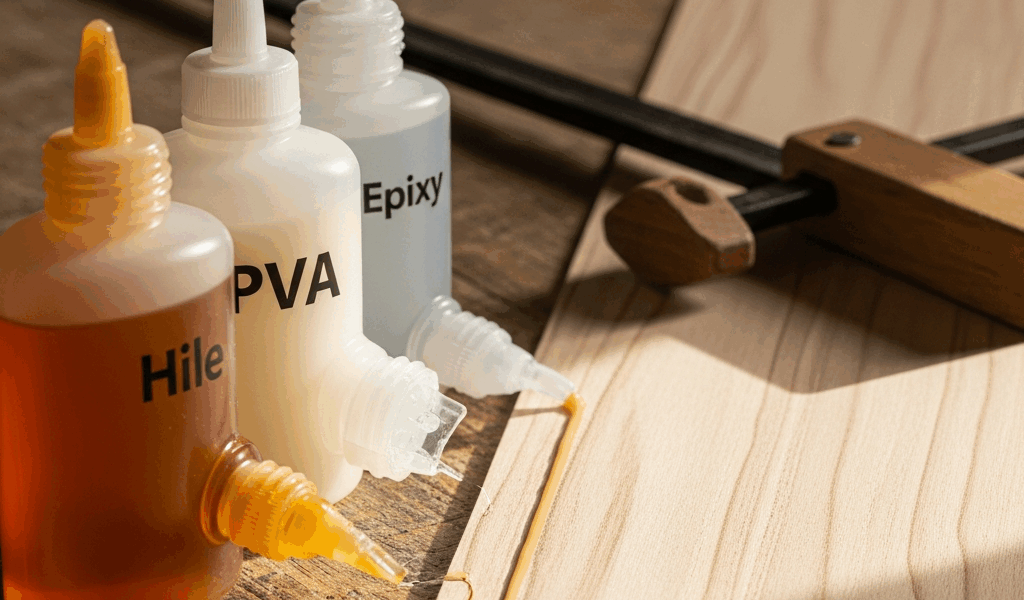
Hide glue won’t creep. Urea formaldehyde resin won’t creep. Epoxy won’t bleed. But they all have trade-offs in reversibility, cure time, and application difficulty that actually matter when you’re choosing your bottle. The right glue depends on your specific job, not on what’s cheapest or most popular.
The Rankings — Best Glue by Veneer Job
PVA (Titebond Original or II) — Small Flat Panels with Cauls and Clamps
For a small tabletop veneer panel where you’re clamping with wooden cauls and solid parallel pressure, PVA adhesives work fine. Titebond Original ($8–12 per bottle, 16 oz) has a longer open time than Titebond II ($6–10), which matters when you’re positioning veneer by hand. The creep issue I mentioned is real, but it’s manageable if you apply the glue thin — maybe 1/32 inch — and maintain clamping pressure for a full 24 hours.
Use PVA only if you’re not vacuum pressing. The moment you switch to vacuum for larger panels, the sustained pressure accelerates creep and you get visible telegraphing. I’ve measured it: a 4×8 panel pressed for 8 hours shows visibly more substrate outline than one clamped for 24 hours at lower pressure. Simple physics. PVA relaxes under prolonged load.
Urea Formaldehyde Resin — Vacuum Pressing and Zero-Creep Requirements
Frustrated by creep under sustained vacuum pressure, industrial shops switched to urea formaldehyde resin decades ago, and the standard stuck. Bondo Cascopal UF6 ($25–35 per kit, mixed batch) or similar UFR systems set hard and rigid. No creep. The glue line stays put under the 10–15 PSI sustained vacuum pressure for 6–12 hours. I’ve never seen telegraphing with UFR, and I’ve pressed dozens of 4×6 panels.
The trade-off is irreversibility and moisture sensitivity. UFR sets in a brittle cross-link that won’t soften with heat or moisture later. If you’re repairing an antique veneer, avoid this. If you’re building production panels for a humid kitchen cabinet, UFR is your answer. Also: UFR needs precise powder-to-water ratio and a 15–20 minute pot life once mixed. You can’t save the batch.
Hide Glue — Hammer Veneering and Reversible Antique Repair
Hide glue is the only adhesive that stays reversible decades later. Franklin’s Liquid Hide Glue ($12–18, 16 oz) or traditional pearl hide in hot clamp (higher working quality but more setup) will soften with moisture and gentle heat, allowing you to lift a misplaced veneer or repair a damaged antique without destroying the base. Museums use hide glue for this exact reason.
For hand hammer veneering—the old technique where you lay veneer into wet glue and beat it down with a veneer hammer—hide glue is nearly mandatory. The long open time (5–10 minutes) and the way it grabs when heated let you position veneer precisely. Modern woodworkers rarely do this, but if you’re working on period-correct restoration or learning traditional methods, nothing else behaves the same way.
The limitation: hide glue is moisture-sensitive in service. A tabletop in a humid kitchen will show problems. Save it for indoor furniture in climate-controlled spaces and for repair work where reversibility is the point.
Epoxy — Oily Exotics and Wet Environments
West System epoxy ($20–40 per kit, 205 hardener + 105 resin) or similar two-part epoxy is your only real option for oily wood species that reject water-based adhesives. Rosewood, cocobolo, teak, and some African hardwoods have natural oils and silica that interfere with glue wetting. Epoxy just doesn’t care. It cures through a chemical reaction, not evaporation, so oil content doesn’t matter.
Epoxy also tolerates moisture. If your veneer panel will live in a bathroom or exterior application, epoxy handles seasonal humidity cycling better than anything else. Hide glue softens. PVA fails. UFR can delaminate. Epoxy stays put.
The problems: epoxy is expensive, slow (overnight at room temperature, or hours with heat), and you need exact 2:1 or 5:1 mixing ratio (varies by product). It also doesn’t sand as cleanly as other adhesives when squeeze-out hardens. You’ll have a harder time keeping the veneer face clean during application. But if your substrate is oily or your environment is wet, epoxy is the only guarantee.
What to Avoid — Contact Cement and CA Myths
Contact cement is not a veneer adhesive. Period. It’s fine for edge banding and laminate edge trim on flat surfaces where minimal stress applies. On face veneer, contact cement creeps significantly, and it never really hardens — it stays rubbery. You’ll see movement and lifting within months. I’ve salvaged three jobs where the woodworker mistakenly used contact cement, and every single one required re-veneering.
Cyanoacrylate (CA, super glue) is a spot-repair tool. Use it to lock a lifting edge or fill a gap in a failed joint. Don’t use it as your primary veneer adhesive. CA sets instantly and doesn’t fill gaps, so you need perfect veneer-to-substrate contact across the entire face. One air pocket and you have a telegraph. Plus, CA is brittle when cured. It doesn’t flex with wood movement, so seasonal humidity cycling will crack the glue line.
Application Technique That Matters More Than Brand
Here’s what changed everything for me: the adhesive family matters less than application thickness and pressure profile. Squeezed-out glue pooling around the edges doesn’t mean the glue line is properly saturated. It means you applied too much. Veneer telegraphing doesn’t always mean you chose the wrong glue — it usually means you spread glue unevenly or released clamping pressure too soon.
Spread adhesive thin and even. A glue roller ($8–15, rubber core) or a notched trowel spreader (3/32-inch notch for veneer) applies the right amount with one pass. PVA spreads like butter. UFR mixes thicker and needs a stiffer spreader. Hide glue warms in a hotpot ($20–30) and flows like water.
Clamp or press uniformly. Gaps in caul pressure create voids. Vacuum pressing needs 10+ PSI held for the full open time to squeeze out air and seat the veneer. Eight hours is standard. Overnight is safe. Open time varies by adhesive and temperature — PVA is open for 10–15 minutes at 70°F, UFR for 15–20, hide glue for 5–10 when heated. Check the bottle.
Don’t trim veneer overhang until the glue is fully cured, not just tack-set. I’ve watched veneer shift during trimming when the glue was still green, ruining otherwise perfect work. Twenty-four hours minimum for PVA, 48 hours for UFR, 6 hours for hide glue at room temperature.
Quick Answer Table and Final Pick
| Job Type | Best Glue | Why |
|---|---|---|
| Flat panel, cauls, small | Titebond Original | Easy, low cost, sufficient for clamp pressure |
| Vacuum press, production | UFR (Cascopal UF6) | Zero creep, industrial standard |
| Antique repair, reversible | Franklin’s Hide Glue | Softens with heat/moisture, reversible |
| Oily wood, wet environment | West System Epoxy | Cures chemically, tolerates moisture |
| Curved work, hammer veneer | Hide glue (pearl, heated) | Long open time, controllable grab |
The one-bottle answer: If you’re a hobbyist doing occasional flat veneer panels with cauls and clamps in a climate-controlled workshop, buy Titebond Original ($8–12). It’s not perfect — nothing is — but it’s nearly impossible to fail with, and it handles the most common veneer job reasonably well. You’ll apply it thin, clamp for 24 hours, and never see a problem.
If you’re pressing panels regularly under vacuum, invest in a UFR system. The $25–35 kit outlay pays for itself after three or four panels. If you’re doing antique work, hide glue is non-negotiable. If your veneer species is oily or your piece lives in a wet space, epoxy. Choose the adhesive family first by application. Choose the specific brand second.

Stay in the loop
Get the latest master wood crafters updates delivered to your inbox.