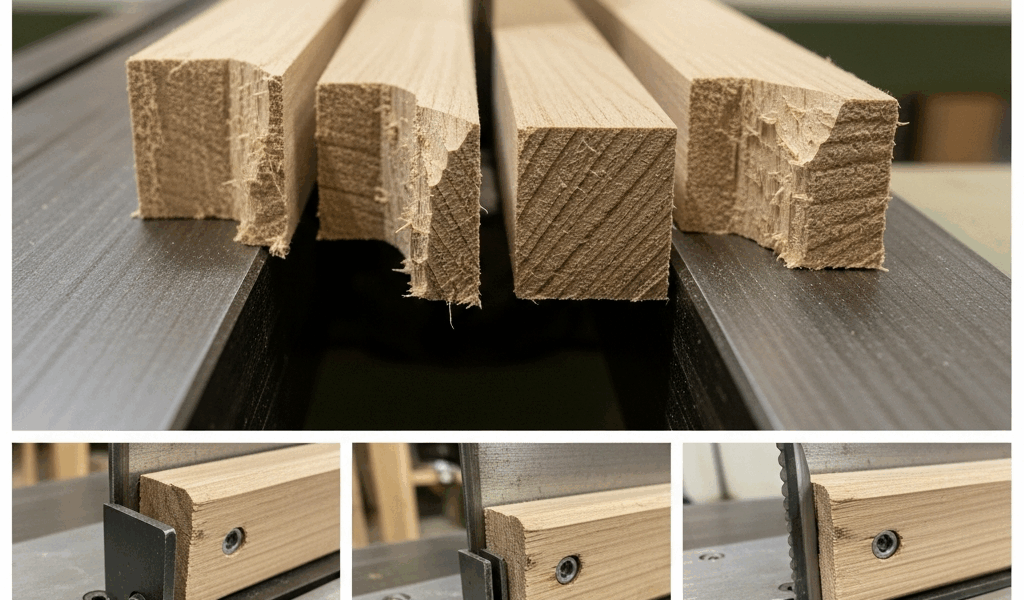
What Jointer Snipe Actually Looks Like
Jointer snipe has gotten complicated with all the conflicting advice flying around. Ask three woodworkers and you’ll get four answers. I’ve been there — standing at my bench with a board that looked perfect until the last two inches, wondering what I did wrong this time.
But what is jointer snipe? In essence, it’s a shallow dip or gouge at the trailing end of your board — sometimes the leading end too — that appears right when you think the piece is done. It’s a quarter-inch-deep frustration that makes you want to run the board back through. Except you can’t without making it worse. But it’s much more than just a cosmetic annoyance.
Jointer snipe is different from planer snipe, though both will ruin your afternoon equally well. On a jointer, it happens because of how the board sits relative to the cutterhead as it exits the infeed side. The board tips. The trailing edge drops into the knives. There goes your flat surface.
I’ve gotten three different explanations for this same symptom from three different woodworkers. That told me something important — jointer snipe usually has one root cause, and once you identify which one, the fix is straightforward. So, without further ado, let’s dive in.
Cause 1 — Outfeed Table Is Set Too Low
This is the culprit about 70 percent of the time. Probably should have opened with this section, honestly, because once you understand what the outfeed table is supposed to do, everything else clicks into place.
The outfeed table exists for one reason: to catch the board after it passes over the cutterhead knives. For it to do that job, it must sit exactly level with the apex of those knives — the highest point where they’re spinning. If your outfeed table is even 1/32 inch too low, the trailing end of the board will dip as it loses support from the infeed side and hasn’t yet landed safely on the outfeed table.
Here’s how to check it. Get a decent straightedge — I use a Starrett 48-inch that cost me around $70 and has saved me from problems far worse than snipe. Place it across both tables, parallel to the knives. If light shows under the straightedge between the outfeed table and the knife apexes, your outfeed table is sitting too low. Simple as that.
The fix: raise the outfeed table in small increments. We’re talking 1/64 inch at a time. Most jointers have a height adjustment screw at the front and rear of the outfeed table. Loosen the lock nuts, turn the screws clockwise to raise, retighten. Test on a scrap board. Repeat.
You’ll know it’s right when the board transfers from infeed to outfeed with no rocking motion whatsoever. It should feel like one continuous, level surface. No tippy feeling. No hesitation. Just smooth.
Overshoot it and set the outfeed table too high, though, and you’ll get a different problem entirely — the board will bind or the trailing end will start to round over. Back off a quarter turn and test again. Three or four passes usually dials it in perfectly. That’s normal. Don’t get discouraged.
Cause 2 — Lifting Pressure at the End of the Cut
This one is a technique issue, not a machine issue. Your jointer might be perfectly fine. Your hands might be the actual problem.
When feeding a board through the jointer, your pressure needs to transfer from the infeed table to the outfeed table before the board clears the cutterhead entirely. That transition is everything. Keep pushing down on the infeed side as the board’s trailing end approaches the knives, and the board tips forward. The trailing edge drops. Snipe happens — and you’ll blame the machine when it was you all along.
Boards under 18 inches long are especially vulnerable here because there’s less surface area supporting them during that transfer moment. A 12-inch board needs your hands to shift pressure roughly 6 inches before the trailing end even reaches the cutterhead. That’s earlier than most beginners expect.
The fix: practice the hand transfer on scrap wood first. As the board moves forward, infeed-side hand pressure decreases while outfeed-side hand pressure increases. Your outfeed hand should be actively guiding the board onto the outfeed table before the knives finish cutting the trailing edge. It feels awkward at first. That’s fine.
Use a pencil to mark where the snipe zone appears on your test pieces. If snipe disappears when you consciously shift pressure earlier, you’ve found your root cause. Zero machine adjustments required — just a change in technique. That’s what makes this fix endearing to woodworkers who’ve spent hours tweaking their machines for no reason.
Cause 3 — Infeed Table Height or Worn Gibs
This is the less obvious culprit. Worth checking before you decide your hand technique is the problem — don’t make my mistake of skipping this step and wondering why your “fixed” technique still produces snipe.
The infeed and outfeed tables should be perfectly co-planar, sitting in the same plane relative to each other. If the infeed table rides higher than the outfeed table, the board is essentially being fed downward as it passes the knives. That angle creates snipe on the trailing end every single time. Most jointers have height adjustment at the front and rear of the infeed table, same as the outfeed side.
The other possibility here: worn gibs. Gibs are the metal strips that keep the tables sliding smoothly without excessive play. On a used jointer — and most of us are running used jointers — they wear out eventually. When they wear, the table flexes slightly under feed pressure. That flex adds up to snipe, especially on thicker stock like 8/4 lumber.
To check for table slop, grab the edge of the infeed table and try to rock it by hand. There should be almost zero movement. If the table rocks noticeably, you’ve got worn gibs. That’s a service situation unless you’re comfortable pulling the jointer apart. I’m apparently a glutton for punishment, and tearing down my 1980s Powermatic 60A works for me while watching quick repair videos never did — took a full afternoon, a set of feeler gauges, and more patience than I expected. Don’t make my mistake of rushing that process.
If the infeed table is just slightly high rather than gib-related, adjust it using the same method as the outfeed table. Small incremental turns of the height adjustment screws, test on scrap, repeat until it’s right.
How to Test Your Fix Before Running Good Stock
Don’t run your best walnut through until you’ve actually verified the snipe is gone.
Grab some poplar or pine — something cheap you don’t mind ruining. Make a pass at your normal feed speed. Before you pull the board away, mark the trailing end with a pencil to show exactly where the snipe appears. Then measure the depth with a caliper. I use a cheap $22 digital caliper from Harbor Freight. It’s fine for this.
Good woodworking generally tolerates snipe up to about 1/64 inch. Beyond that, you’re adding serious sanding time. If your snipe is under 1/64 inch and only catches the light at certain angles, you can live with it. Deeper than that, keep adjusting.
Run another test board after each individual adjustment. Seems slow. It’s actually faster than running a board you care about and having to flatten it twice because you were impatient.
Here’s the honest truth — most jointer snipe is fixable in under 15 minutes once you know which cause you’re actually dealing with. Outfeed table too low takes maybe five minutes and four test passes. Bad hand technique takes ten minutes of practice on scrap. Worn gibs or infeed table misalignment might stretch to 15 minutes of careful adjustment. None of these are catastrophic, machine-breaking problems. You’ve got this.

Stay in the loop
Get the latest master wood crafters updates delivered to your inbox.