Seasonal wood movement has gotten complicated with all the conflicting advice about moisture meters, acclimation times, and finish choices flying around. As someone who has built furniture through twenty years of humid summers and dry winters, I learned everything there is to know about designing around the fact that wood never stops moving. Today, I will share it all with you.
Wood moves. Accept this truth or fight your projects forever. Every board in your shop right now is responding to the humidity in the room, swelling when moisture increases and shrinking when it decreases. Ignore this movement and your carefully crafted joints will self-destruct by next spring.
The Science Behind It

Wood cells are essentially bundles of tiny tubes that absorbed water when the tree was alive. After kiln drying, those tubes still absorb and release moisture from the surrounding air. As they absorb water they swell. As they release it they shrink. This cycle never stops.
Probably should have led with this section, honestly. The movement is not uniform in all directions, which is the part that causes real problems. Tangential movement across the growth rings is typically twice the radial movement through the rings. This differential causes flat-sawn boards to cup while quartersawn boards stay relatively flat. Neither type stays completely still.
Movement along the grain is negligible, usually less than 0.1 percent. This is why rails and stiles can be long without worrying about length change, but panels must have room to change in width. Understanding this single fact eliminates most wood movement mistakes.
How Much Movement to Expect
A 12-inch-wide red oak panel might vary by a quarter inch or more between summer humidity and winter heating season. Cherry moves less, around three-sixteenths of an inch across the same width. Teak, one of the most dimensionally stable woods available, might move only an eighth of an inch. These numbers assume typical indoor humidity swings from 30 to 70 percent.
Your specific environment matters more than published averages. A house with forced-air heating and no humidifier can drop to 20 percent relative humidity in January. That same house in a humid summer climate might hit 80 percent in August. The wider the seasonal humidity swing, the greater the wood movement you need to accommodate.
Joints That Handle Movement
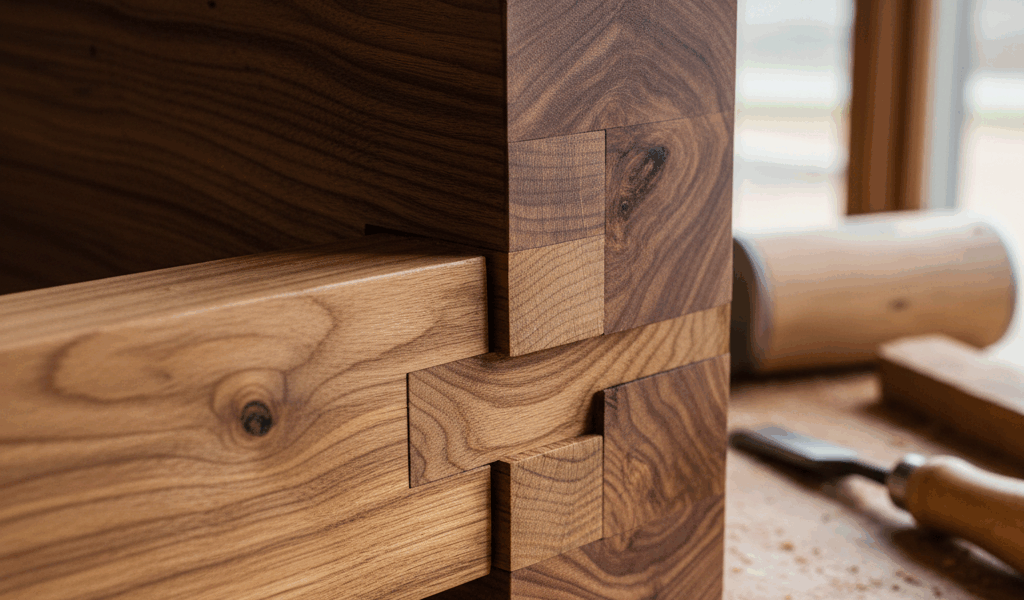
That’s what makes frame-and-panel construction endearing to us furniture makers who think long-term — the floating panel sits in grooves in the frame, free to expand and contract without stressing the structure. Never glue a solid wood panel into its frame grooves unless you want cracks or buckling within the first year.
Breadboard ends use a similar principle. The tongue along the panel edge slides within the breadboard groove. Only the center gets glued while the outer portions float on elongated screw slots that allow the panel to move beneath the fixed breadboard. Glue the entire length and the panel will crack or the breadboard will bow.
Tabletop fasteners — metal Z-clips or wooden buttons — connect tops to aprons while allowing cross-grain movement underneath. Screws through slotted holes accomplish the same thing less elegantly but just as effectively.
Getting Grain Orientation Right
When joining solid wood, align grain directions so movement is parallel between mating pieces. A frame-and-panel door works because all four frame members move in the same direction while the panel floats independently inside the grooves.
Cross-grain construction, where one board’s grain runs perpendicular to another, invites failure. The classic mistake is attaching solid wood edging across a plywood panel with continuous glue. The plywood stays dimensionally stable while the solid wood tries to move seasonally, resulting in gaps during dry months, buckling during humid months, or splits that appear without warning.
Seasonal Building Realities
Building during summer humidity and delivering to a winter-heated home creates the worst possible scenario. The lumber you are cutting carries extra moisture that will leave during heating season, causing everything to shrink. Drawers that fit perfectly in July will have gaps in January.
Ideally, acclimate your lumber to its final environment before building. Let boards sit in the destination space for several weeks. When that is impractical, build during the season closest to average annual conditions and accept some variation at the humidity extremes.
Design Strategies
Wide panels cause more problems than narrow ones because absolute movement is proportional to width. Two 8-inch boards glued together move twice as much as a single 8-inch board. Consider whether your design can use narrower panels or additional frame members to break up large surfaces.
Strategic placement of fixed points controls where movement appears visually. Glue the center of a panel and let both edges float, and expansion splits evenly to both sides. Glue one edge only, and all movement goes to the opposite side. Choose based on where seasonal gaps would be least visible or least problematic for your design.
Wood movement is not a defect to overcome. It is a material property to respect and design around. Build with movement in mind from the initial sketch, and your furniture will look as good in ten years as it does the day you deliver it.



Stay in the loop
Get the latest master wood crafters updates delivered to your inbox.