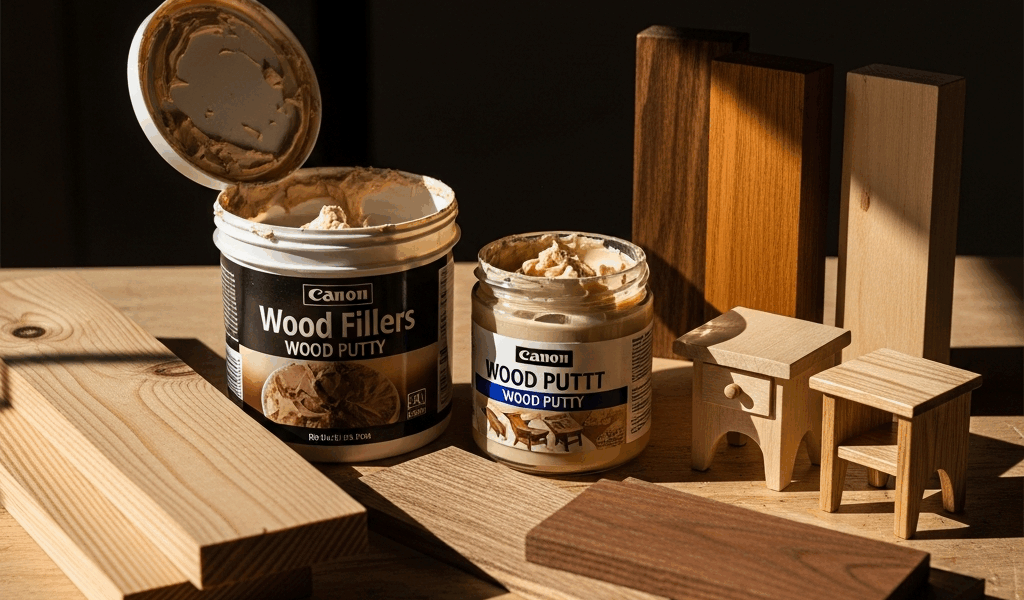
The One-Line Rule That Settles Most Arguments
Wood filler vs wood putty has gotten complicated with all the conflicting advice flying around. But the answer is simpler than most articles make it sound. Here it is: wood filler goes on raw, unfinished wood before you apply a finish; wood putty goes on wood that’s already finished. That’s the whole thing. Every other distinction flows from that one rule.
This article includes affiliate links. We may earn a commission at no extra cost to you.
As someone who built a white oak dining table in my garage about four years ago, I learned everything there is to know about this distinction — the hard way. I grabbed a tub of DAP plastic wood putty — the tan-colored stuff, around $6 at Home Depot — to fill some grain voids before staining. The putty just sat there on the surface like a beige island. Completely refused to absorb any Minwax Early American. I ended up hand-sanding the entire top back down to bare wood. Two days of work. Gone. If someone had just told me the one-line rule up front, I’d have saved the weekend.
Probably should have opened with this section, honestly.
What Wood Filler Actually Is and When to Reach for It
Wood filler is a stiff, paste-like compound designed to be worked into raw wood — knots, deep gouges, cracks, open grain — before any stain or topcoat touches the surface. It hardens. That’s the key behavior. Once it cures, you can sand it flush, shape it with a chisel, and in most cases apply stain right over it. But what is wood filler, really? In essence, it’s a pore-filling repair compound engineered for bare wood. But it’s much more than that.
Water-Based vs Solvent-Based
Most of what you’ll find at a home center is water-based filler. Products like Elmer’s Carpenter’s Wood Filler or Minwax Stainable Wood Filler in that small yellow tub. They clean up with water, dry in roughly 30 to 60 minutes, and sand well. Solvent-based fillers like Famowood Original are denser, more durable, better for exterior work or large voids. They also smell serious. Work outside or crack a window — at least if you don’t want a headache by noon.
The Staining Problem Nobody Mentions
Here’s where most woodworkers get burned. Water-based wood fillers claim to be stainable. Technically, they are. But “stainable” doesn’t mean “matches the surrounding wood when stained.” It means the filler absorbs some color. How much color, and whether it looks anything like the natural grain next to it — that’s a different question entirely.
Open-grain woods like oak and ash are especially unforgiving. The filler sits differently in the pore structure than the surrounding wood fiber does. You’ll see the repair. The only reliable workaround is tinting your filler before application. Mix a small amount of your stain directly into the filler, run a test patch on scrap from the same board, let it dry completely, then apply your stain coat over it. Not a perfect system. But it gets you close.
Best use cases for wood filler: large knot holes before a painted finish, grain gaps in pine before a natural oil finish, deep gouges in furniture you’re refinishing from scratch, and any structural void where you need something that cures hard enough to be re-drilled or shaped.
What Wood Putty Actually Is and When to Reach for It
Wood putty is a different animal. Softer, stays slightly flexible even after it dries, and built for touching up surfaces that are already coated. The most common scenario — filling nail holes after painting trim — is exactly what putty was designed for. You shoot your finish nails, paint the trim, then come back with a color-matched putty and press it into the holes with your thumb. Done. That’s what makes putty endearing to us finish carpenters.
Because putty doesn’t harden fully, it flexes with the wood as it expands and contracts through seasons. Genuinely useful for outdoor furniture. Oil-based putties like DAP Plastic Wood-X or Minwax Stainable Wood Filler — confusingly named, it’s closer to a putty — hold up better on exterior pieces than their water-based cousins.
The Warning Worth Repeating
Do not use wood putty under a stain finish. It will not absorb stain color the way raw wood does. The repair will be visible. It may also fail to bond properly to bare wood because it’s formulated to adhere to coated surfaces. Putty on finished wood only — that’s the job it’s engineered for. Don’t make my mistake.
Color matching matters enormously with putty. Most brands sell a range — Elmer’s alone carries about a dozen shades, from Natural Pine to Dark Walnut. Buy the one that matches your finish, not your raw wood. The finish changes the color significantly, and putty shifts too once it dries. Test a dab on an inconspicuous spot, let it cure for an hour, then compare.
Side-by-Side Comparison Table
| Feature | Wood Filler | Wood Putty |
|---|---|---|
| Use timing | Before stain or finish | After finish is applied |
| Sandability | Yes — sands smooth when cured | Limited — gums up sandpaper |
| Stainability | Partial — inconsistent color match | No — does not absorb stain evenly |
| Flexibility when dry | Rigid — hardens fully | Slightly flexible — stays pliable |
| Drying time | 30 minutes to 2 hours | 2 to 8 hours (oil-based takes longer) |
| Indoor vs outdoor | Mostly indoor; solvent-based for exterior | Oil-based options work outdoors |
| Best for painted projects | Yes, before paint | Yes, after paint |
| Best for stained projects | With tinting — still imperfect | No |
The Mistakes That Wreck a Finish and How to Avoid Them
Frustrated by blown finishes and mismatched repairs, most woodworkers eventually compile a short mental list of what not to do. This new habit of cataloging failures took off several years into my shop work and eventually evolved into the checklist enthusiasts know and swear by today. So, without further ado, let’s dive in.
Mistake One — Putty Before Stain
Already covered this. But it’s worth repeating because it’s the most common error. Putty repels stain. Fill a crack with putty on raw wood, apply a gel stain, and you’ll end up with a clearly visible pale patch surrounded by rich, colored grain. There’s no fixing it without stripping the whole surface. Use filler instead. Tint it. Test it first.
Mistake Two — Filler on a Finished Surface
Wood filler doesn’t bond reliably to a cured finish. Too smooth, too non-porous. Even if you get it to stick initially, it’ll crack or pop free when the wood moves. I’m apparently sensitive to humidity swings and Famowood works for me while generic store-brand filler never holds on sealed surfaces. If you’re doing touch-up work after the topcoat is already down, reach for the putty. That’s what it’s there for.
Mistake Three — Wrong Color, Both Products
Picking a color in the store under fluorescent lighting and applying it in your garage or living room is a recipe for a mismatch. Always buy two shades — one lighter, one darker than you think you need — and test both before committing. A $4 test saves a $40 redo.
Quick Buying Recommendations
While you won’t need a full woodworking arsenal, you will need a handful of reliable products. First, you should grab Famowood Latex Wood Filler — at least if you’re working on bare wood with stain in your plans. It runs $8 to $12 for a 6 oz tub, sands cleanly, and takes tint without getting weird. Elmer’s Carpenter’s Color Change Wood Filler might be the best putty option, as interior painted trim requires something forgiving and readable. That is because it goes on pink and turns white when it’s ready to paint over — takes the guesswork out of timing completely. Around $6 at most hardware stores. Both are widely available. Both do exactly what they say.
Know which surface you’re working on — raw or finished — and the right product picks itself.



Stay in the loop
Get the latest master wood crafters updates delivered to your inbox.