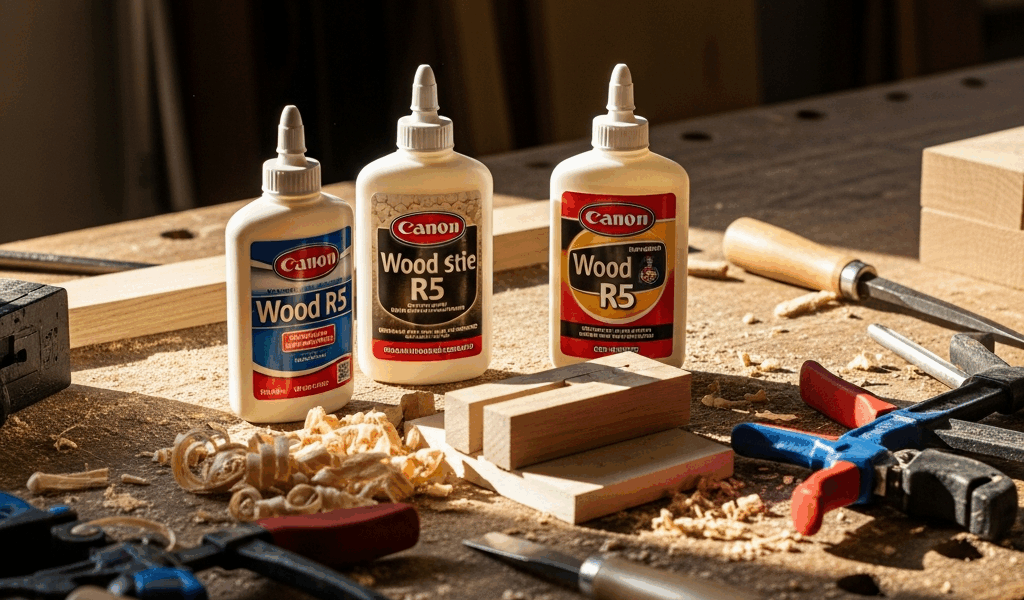
Titebond III vs II vs Original — Which Wood Glue for What Job
Titebond III vs II vs Original has gotten complicated with all the forum arguments and contradictory YouTube advice flying around. For years, honestly, I just grabbed whatever yellow bottle was closest to the bench — didn’t think twice about it. That stopped the day I glued up a set of Adirondack chairs with Original Titebond, left them outside through a Michigan winter, and came back in April to find the arm joints had opened up like a book. The wood was fine. The glue wasn’t. Expensive lesson, that one. Don’t make my mistake.
Quick Answer — Titebond II for 90% of Projects
Probably should have opened with this section, honestly. Titebond II is the right default glue for almost every project sitting on your bench. Interior furniture, cabinet boxes, face frames, drawer boxes, shop jigs, picture frames, wood toys — II handles all of it without asking you to think twice.
But what is Titebond II, exactly? In essence, it’s a water-resistant PVA adhesive rated to ANSI Type II. But it’s much more than that — it’s the one bottle you can reach for on autopilot and almost never be wrong. Water-resistant isn’t the same as waterproof, which is a distinction worth understanding, but water-resistant is genuinely good enough for anything living inside a house. A bathroom vanity cabinet, a kitchen shelf, even a cutting board getting rinsed and dried every night — II handles all of those without complaint.
Cleanup is dead simple. Wet squeeze-out wipes off with a damp rag. Dried glue sands cleanly without gumming up your paper the way some adhesives will. Open time sits around 5 minutes in a 70°F shop — enough working time for most single-glue-up assemblies without making you sweat.
Price-wise, a 16 oz bottle at my local Woodcraft runs about $8.99. A quart is usually around $13.50. For a shop running 20-plus projects a year, paying III prices for every indoor build is just money going nowhere.
The bond itself is stronger than the wood on a long-grain joint. Full stop. Test it right and the wood fails before the glue line does — that’s true of all three Titebond formulas, so don’t let anyone talk you into buying III because it’s “stronger.” For long-grain indoor applications, you’re not buying more strength with III. You’re buying water resistance. Nothing else.
When You Need Titebond III
I reached for Titebond III the first time on a teak outdoor dining table I built for a client about six years ago. Teak is naturally oily — already a tricky species for PVA adhesion — and the piece was going onto a covered but fully exposed patio in western Washington. That combination pushed me toward III without much debate.
Titebond III is fully waterproof by the ANSI/HPVA Type I standard. That’s the rating that matters for true outdoor exposure — rain, standing water, humidity swings across seasons. II is only Type II rated, meaning it passes water resistance tests but not full waterproof immersion. For outdoor furniture sitting through wet Pacific Northwest winters, that gap is real and it matters.
The other application where III earns its keep is cutting boards — specifically end-grain boards that get washed frequently. Titebond III carries FDA approval for indirect food contact. Original and II do not. Worth noting: once any of the Titebonds fully cure, they’re generally considered safe regardless. But if you want the official paperwork and the peace of mind, III is your only choice in this lineup.
Outdoor projects that clearly belong in III territory:
- Adirondack chairs, benches, outdoor tables
- Garden planters or window boxes built from wood
- Dock cleats, deck furniture, pergola joinery
- End-grain cutting boards and butcher blocks for heavy kitchen use
- Exterior door components or shutters
The tradeoff is open time and cost. III gives you roughly 8–10 minutes of open time versus II’s 5 minutes — sounds like an advantage, and sometimes it is — but that extended assembly window also means longer clamp time. Figure on a minimum of one hour under clamps, full cure at 24. A quart of III runs $17–$19 compared to $13.50 for II. Not dramatic on a single bottle, but it accumulates across a busy build season.
When Original Titebond Is Actually the Right Call
Original Titebond gets unfairly dismissed as the cheap old version, and that reputation isn’t accurate. That’s what makes it endearing to us woodworkers who’ve actually used all three side by side — it has a specific set of strengths the other two don’t replicate.
Original — the red label — has the longest open time of the three. Somewhere in the 4–6 minute range, but more importantly, it has a slightly slower initial tack that gives you freedom to reposition pieces during assembly. For complex glue-ups — a curved bent lamination, a multi-piece furniture component with a dozen parts coming together at once — that extra working time can be the difference between a clean assembly and a panic-fueled disaster with clamps flying everywhere and nothing square.
I use Original on fine furniture joinery where I need to be methodical. Mortise and tenon assemblies with multiple joints going together simultaneously. Bent laminations around a form where repositioning is part of the process. Shop fixtures that are purely indoor and will never see moisture of any kind.
It sands beautifully — I mean that sincerely. The dried glue line is slightly softer than cured III, which means it responds well to hand planes and card scrapers. Useful when you’re doing fine furniture work and cleaning up glue lines before finishing. III resists the scraper a little. Original doesn’t fight you.
Cost is the lowest of the three, which makes it genuinely attractive for large shop jigs, workbench builds, or any project where you’re burning through a lot of glue and water resistance is irrelevant. A quart of Original runs about $11–$12.
Where it absolutely does not belong — outdoor applications, high-moisture environments, cutting boards. The original formula has no meaningful water resistance rating whatsoever. That’s the Adirondack chair mistake I described up top. The arms just peeled open. It was embarrassing and it cost me a full weekend of repair work.
The Differences That Actually Matter
Side by side, no fluff:
| Feature | Original | Titebond II | Titebond III |
|---|---|---|---|
| Water Resistance | None | Water-resistant (ANSI Type II) | Waterproof (ANSI Type I) |
| Open Time | 4–6 min | ~5 min | 8–10 min |
| Cleanup | Water (wet) | Water (wet) | Water (wet), slightly harder dried |
| FDA Indirect Food Contact | No | No | Yes |
| Price Per Quart (approx.) | $11–$12 | $13–$14 | $17–$19 |
| Sandability | Excellent | Very good | Good (slightly harder) |
| Best Use | Fine indoor furniture, complex assemblies | General indoor woodworking | Outdoor, cutting boards, high moisture |
One thing the table doesn’t capture — temperature sensitivity. All three Titebonds are PVA-based, all three share the same minimum application temperature of 45°F. Work in a cold unheated shop through winter and you’re running into the same problem regardless of which formula you grabbed. Glue stored below freezing will often be ruined outright — the emulsion breaks and you end up with something resembling cottage cheese in a bottle. Keep your bottles somewhere heated. Lost a full quart of III last January because I left it in the barn overnight. Not doing that again.
Cross-Grain Gluing and Other Special Cases
Here’s where we need to be honest about what PVA glue — any PVA glue, including all three Titebonds — cannot reliably do.
Long-grain to long-grain joints are where PVA glue excels. Edge gluing boards for a tabletop, gluing face frames, joining drawer parts — all long-grain contact, all excellent candidates for any Titebond formula. The glue line will outlast the wood. That’s not marketing copy. That’s just what happens with a properly prepared long-grain joint and adequate clamping pressure.
Cross-grain gluing is a different situation entirely. Wood moves across its grain as humidity changes — expands and contracts seasonally, no stopping it. Glue two pieces with opposing grain directions rigidly — a breadboard end attached flat across a tabletop, for example — and you’re fighting the wood’s natural movement with a rigid glue line. That joint will eventually fail, or more often the wood itself cracks first. The answer there isn’t a better glue. It’s a different joinery method — elongated slots, mechanical fasteners with room to move, or breadboard joinery done with drawbore pegs and limited glue surface at center only.
End-grain joints are genuinely weak with PVA. The wood fibers soak up the adhesive like a sponge, leaving a glue-starved joint that feels solid until it suddenly isn’t. If you have to glue end grain, apply a thin sizing coat first, let it tack up for a few minutes, then apply a full glue coat and clamp normally. That helps — not a perfect fix, but it helps. For structural end-grain joints under real load, mechanical reinforcement — dowels, pocket screws, a spline — is the smarter call regardless of which adhesive you’re using.
Frustrated by a repair job on an antique where the original joints were end-grain and had to stay that way, I started keeping a tube of Gorilla Glue on the bench alongside the Titebonds. Polyurethane glue foams into end grain and provides a mechanical interlock that PVA simply doesn’t offer. It’s not my first choice for anything — cleanup is genuinely a nightmare and the foaming creates squeeze-out problems — but for that specific end-grain repair scenario, it does something PVA can’t replicate.
Epoxy might be the best option for oily tropical species, as that application requires gap-filling capability and real adhesion on contaminated surfaces. That is because teak, rosewood, and other dense species with high natural oil content can give PVA real fits — the oils interfere with bonding in ways that aren’t always predictable. Wiping the surface with acetone immediately before gluing helps. For critical joints in those species, two-part slow-cure epoxy — I use System Three T-88 or West System 105/205 depending on what’s in the shop — takes the uncertainty out of it entirely.
Cyanoacrylate — thin CA glue — has a role in the shop too. Primarily for stabilizing checks and small cracks before turning or carving, and for quick-tacking parts during assembly that you’ll reinforce with PVA once everything is positioned. It’s not a structural wood glue. Don’t use it like one.
Bottom line on the whole Titebond debate — buy a bottle of II and make it your default. Add a bottle of III when you’re building anything that will live outdoors or involves a cutting board. Keep some Original on hand if you do complex assemblies where repositioning time matters. That’s three bottles, roughly $40 total at most Woodcraft or Rockler locations, and you’re prepared for almost every gluing situation your shop will throw at you.

Stay in the loop
Get the latest master wood crafters updates delivered to your inbox.