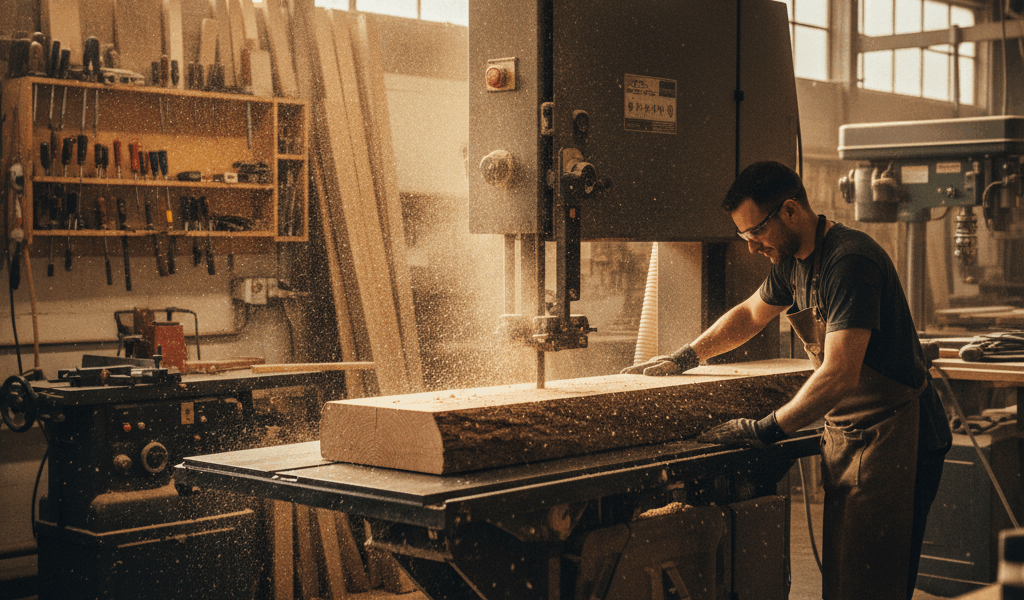
Milling rough lumber into usable stock has gotten complicated with all the videos showing fancy jointer-planer combos and thickness sander setups. As someone who has milled probably thousands of board feet over the years, I learned everything there is to know about what actually matters – and what’s just tool fetishism. Today, I will share it all with you.
A tree becomes lumber through a progression most woodworkers never witness. Understanding this journey transforms how you see every board in your shop. From log to milled stock, each decision affects the wood’s character, stability, and suitability for fine furniture.
At the Sawmill

The sawyer makes choices that determine your lumber’s properties decades later. Plain sawing, cutting boards tangent to the growth rings, produces the most usable lumber from each log. The wide faces show cathedral-shaped grain patterns and respond dramatically to humidity changes.
Quarter sawing cuts boards perpendicular to the rings, producing straight grain lines and exceptional stability. This method yields fewer usable boards and costs more, but the result moves less seasonally and shows distinctive ray fleck in species like oak. Probably should have led with this section, honestly – understanding the cut explains so much about how your boards behave.
Rift sawing splits the difference, cutting boards at 30-60 degrees to the rings. The grain runs relatively straight without the full ray fleck of quartersawing. This method finds use primarily for table and chair legs where consistent grain pattern around all four faces matters.
Green to Dry
Fresh-sawn lumber contains more water than wood fiber by weight. Drying removes this water through either air-drying or kiln-drying, each method producing different results.
Air-dried lumber sits in stickered stacks for months or years, reaching equilibrium with outdoor humidity. The slow process produces stable lumber with rich color development. Air-dried wood typically stabilizes around 12-15% moisture content, suitable for outdoor projects or environments without climate control.
Kiln-drying accelerates the process using heat and controlled airflow. Properly kiln-dried lumber reaches 6-8% moisture content, matching climate-controlled interior environments. The process takes weeks rather than months but can introduce drying stresses if rushed. That’s what makes kiln-drying frustrating sometimes – you’re paying for someone else’s decisions about speed versus quality.
Understanding Rough Dimensions
Lumber thickness is measured in quarters of an inch. A 4/4 board (pronounced “four-quarter”) starts at 1 inch thick, yielding about 13/16 inch after surfacing. An 8/4 board starts at 2 inches and finishes around 1-13/16 inches.
Width and length vary board to board, limited by what the log could yield. This variability makes planning essential; you’re working with whatever widths the lumber provides rather than standardized dimensions. I keep a calculator on my phone specifically for rough lumber math.
Initial Stock Selection
Before milling begins, sort your lumber by intended use. Match grain patterns for visible surfaces. Assign the best boards to prominent locations and relegate flawed stock to hidden parts.
Consider how individual boards will be oriented in the finished piece. A board that looks perfect flat might reveal unflattering figure when positioned vertically. Examine stock from multiple angles before committing. I’ve learned this lesson the hard way more than once – what looks great on the rack looks terrible once it’s in the project.
The Milling Process
Let lumber acclimate to your shop for at least two weeks before milling. This allows moisture content to stabilize in your environment, reducing movement after dimensioning.
Mill in stages rather than all at once. After initial flattening and rough dimensioning, let the boards rest overnight. Internal stresses released by the first milling may cause movement. A second milling pass refines the surfaces after this adjustment. That’s what makes patience endearing to us woodworkers who’ve watched perfectly flat boards twist overnight – you learn to respect the wood’s schedule, not yours.
Don’t mill to final dimension too early. Wood that sits as dimensioned stock will move with humidity changes. Mill to rough size, let it rest, then do final dimensioning immediately before joinery.
Marking Your Stock
As you mill, mark each piece with its intended location in the project. “Left side panel, outside face” tells you exactly how that board should be oriented. These notes save confusion during assembly when many boards of similar dimension lie around the shop.
Keep offcuts organized by species and thickness. That 6-inch cutoff might be perfect for drawer parts on a future project. Every scrap represents material cost and milling time already invested. My offcut rack has saved me more trips to the lumber yard than I can count.
Milling rough lumber connects you to the entire history of woodworking. The skills are the same ones used by furniture makers for centuries. Master them, and you gain access to lumber selection and quality impossible to find in surfaced form.