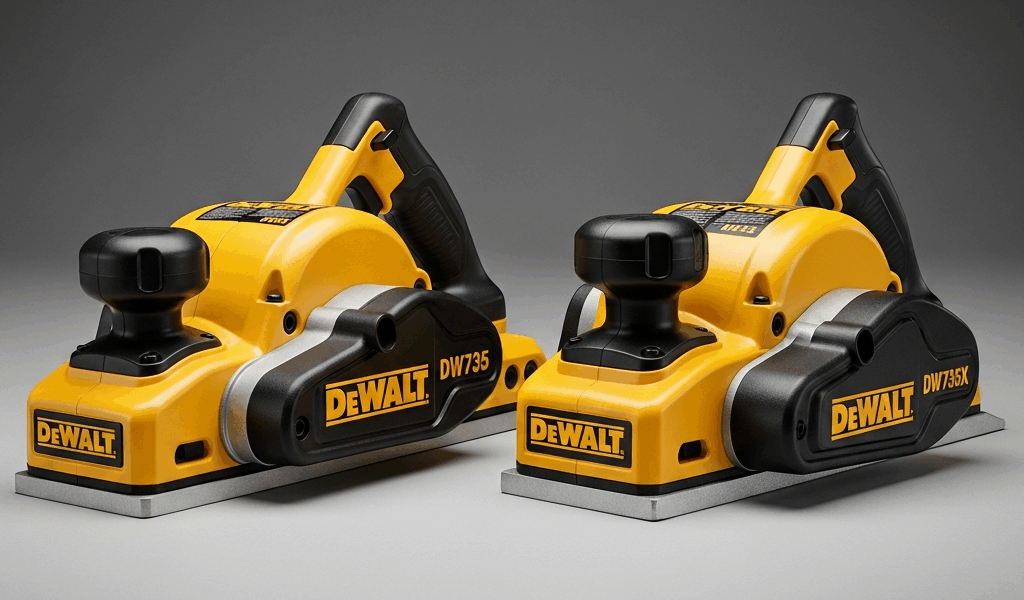
Dewalt DW735 vs DW735X Planer — Is the X Model Worth the Extra
The DeWalt DW735 vs DW735X planer difference comes down to one honest answer: the planer itself is completely identical. Same motor. Same cutting head. Same two-speed gearbox. Same everything under the hood. I’ve run both configurations in my shop and I want to save you the twenty minutes of forum rabbit-holing I did before I figured this out. The X variant is a bundle. That’s it. DeWalt took the DW735, threw in a set of infeed and outfeed tables plus an extra set of blades, slapped an X on the model number, and priced it accordingly. Whether that bundle makes sense for your situation depends entirely on what you already own and what you were going to buy anyway.
The Only Difference — Infeed/Outfeed Tables and Extra Blades
Probably should have opened with this section, honestly, because it answers the whole question before you even read further.
The DW735X ships with two things the base DW735 does not: a pair of folding infeed/outfeed tables and an extra set of three HSS planer blades. That is the complete list of differences. There is no upgraded motor, no better dust collection, no additional depth stops, no improved blade locking system. The machine you get in the DW735X box is the exact same 15-amp, 20,000 RPM cutting head unit you get in the DW735 box.
Here is what those add-ons are actually worth on their own. The DeWalt infeed/outfeed table set — sold separately as the DW7352 — runs about $48 to $55 depending on where you buy. I picked up a set at my local Home Depot for $52 after tax. The replacement three-knife blade set for the DW735 is the DW7352 blade set, which runs roughly $28 to $35 depending on whether you catch a sale. So if you added those two purchases to a base DW735, you’re looking at roughly $80 to $90 out of pocket on top of the planer price.
The price gap between the DW735 and the DW735X at most retailers runs about $50 to $70. When I last checked on a Tuesday afternoon in early spring, the DW735 sat at $549 on Amazon and the DW735X was $599. At some big box retailers the gap is slightly wider, sometimes $80. Do the math and the bundle looks slightly favorable — but only if you need both items.
What the Tables Actually Do for You
The infeed and outfeed tables bolt onto the sides of the planer and extend the support surface for long stock. Without them, you’re hand-supporting anything over about three feet, which works fine if you have a helper or a set of roller stands. The tables fold down when not in use, so they don’t take up permanent real estate. They’re solid, they align well, and they do the job. I used mine for two years before one of the mounting bolts stripped — my fault for overtightening — but overall they’re a quality accessory.
What the Extra Blades Actually Do for You
The DW735 ships with one set of three double-sided HSS blades already installed. The X model adds a second set, still sealed in the packaging, essentially as a spare. When your first set wears down on both edges — which takes a while, maybe 500 to 700 linear feet of hardwood depending on species — you pull them, flip them or swap them out, and you’ve got fresh edges ready. Having that backup set in the drawer is genuinely convenient. I once realized mid-project on a Saturday that my blades were toast and I had no spares. That was a lousy afternoon.
When the DW735X Is Worth It
If you’re setting up a new shop and you don’t already own infeed/outfeed support and you know you want blades on hand, buy the X model. The math supports it. You save $20 to $40 versus buying everything separately, you receive one box, one shipping charge if ordering online, and one trip to the store. Simple.
Specifically, the DW735X makes sense when all three of these apply:
- You’re buying the planer new and have no existing support tables or roller stands
- You plan to run stock longer than 36 inches with any regularity
- You don’t already have a backup blade set sitting in a drawer
New woodworkers setting up their first real shop fall squarely into this category. Frustrated by having to hand-hold eight-foot boards through a planer with no outfeed support — which I did on my first planer, a borrowed Ryobi AP1300, before I knew better — I eventually learned that proper infeed and outfeed support is not optional if you want consistent, snipe-free results. The tables that come with the X model are a genuine quality-of-life improvement if you’re starting from zero.
The bundle also makes sense if you’re buying this as a gift or for a shared shop where you want a complete out-of-the-box setup without requiring someone to track down accessories separately. There’s value in completeness when the end user isn’t the one doing the shopping.
When to Buy the DW735 Base Model
Buy the base DW735 if you already own a pair of roller stands, if your workbench setup handles long stock adequately, or if you’ve built or plan to build a dedicated planer sled with custom support. A lot of shop owners — myself included for about the first year — just use a pair of Rockler adjustable roller stands on either side of the planer. Those stands handle stock up to ten feet without complaint and they serve double duty with the table saw and band saw.
Also buy the base model if you’re sourcing blades separately anyway. Some woodworkers prefer aftermarket carbide-insert blades over the stock HSS knives for longevity, especially if they’re running a lot of figured maple or other hard, abrasive species. In that case the included extra HSS set in the X model is a nice-to-have, not a need.
The situations where the base DW735 wins clearly:
- You already own two roller stands or an outfeed table from another machine
- You’re replacing an older planer and have existing support infrastructure
- You want to invest in carbide replacement blades rather than HSS
- The price gap at your retailer is above $70, making the bundle math worse
- You’re buying refurbished or open box, where the accessories may already be missing
One more thing worth saying plainly: do not pay a $70 premium for the X model at a retailer where the accessory table set is sitting on the shelf for $48. That’s a $22 overpay for a spare blade set you may not need immediately. Check the prices at your specific retailer before deciding.
How the DW735 Compares to Other Benchtop Planers
Assuming you’re still in decision mode and haven’t fully committed to the DeWalt yet, a quick look at the main competition is worth your time. Check our full best benchtop planer guide for deep dives, but here’s the short version.
DeWalt DW735 vs Makita 2012NB
The Makita 2012NB is a 12-inch, two-blade planer that runs quieter than the DeWalt and is genuinely lighter at 62 pounds versus the DW735’s 92 pounds. If portability matters — say you’re bringing the planer to job sites or you share a small shop and it lives on a shelf between uses — the Makita is worth serious consideration. The DeWalt wins on cutting width (13 inches versus 12), feed rate options (96 FPM and 179 FPM versus Makita’s single 26 FPM), and general depth of cut capacity. For a production shop environment where you’re moving volume, the DW735 is the faster, more capable machine. For a hobbyist shop where precision over speed matters more, the Makita holds its own.
DeWalt DW735 vs Ridgid R4331
The Ridgid R4331 is a 13-inch planer that competes directly with the DW735 on paper and undercuts it on price by about $100 at Home Depot. The R4331 is a capable machine with good reviews. Where the DeWalt pulls ahead is in the two-speed feed rate, which gives you options the Ridgid lacks, and in long-term parts availability. DeWalt’s blade and parts ecosystem is simply more established, and if you’re investing in a planer you’ll use for ten or fifteen years, that matters. The Ridgid is the right call if budget is the primary constraint. The DeWalt is the right call if you’re buying once and want a machine with a long service life and no parts headaches five years out.
Bottom line on the DW735 vs DW735X question: you’re buying the same planer either way. The only variable is whether the bundled tables and spare blades represent genuine savings for your specific situation. For most first-time buyers setting up a complete shop, the X model is the smarter buy. For anyone with existing shop infrastructure, the base model saves you money and nothing else changes.


Stay in the loop
Get the latest master wood crafters updates delivered to your inbox.