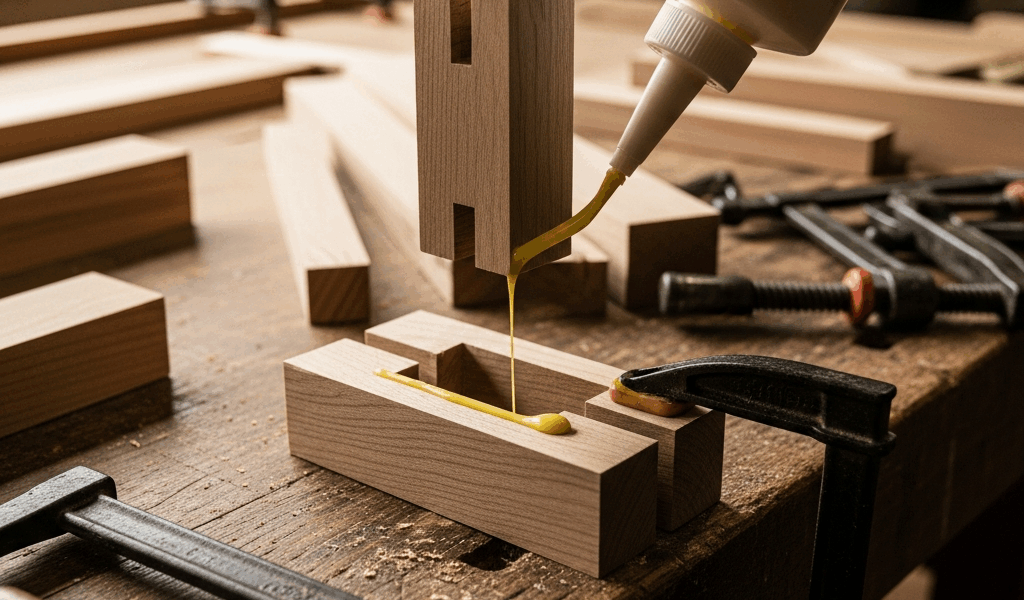
Titebond III. That is the best wood glue for 95% of woodworking projects. Buy it, use it, stop overthinking it.
Now — if your project involves end grain joints, outdoor furniture, gap filling, or antique restoration, the answer gets more specific. Each of those use cases has a better option than standard PVA, and grabbing the wrong bottle costs you either a failed joint or wasted time. Here is the complete breakdown by project type.
The Best Wood Glue for 95% of Projects
Titebond III Ultimate Wood Glue is a type III PVA (polyvinyl acetate) that passes ANSI/HPVA Type I water resistance testing. In plain language: it is waterproof enough for outdoor furniture, stronger than the wood itself in shear (the joint will not fail — the wood around it will), sandable when dry, and cleans up with water while still wet.
For indoor-only projects — bookshelves, cabinets, drawer boxes, cutting boards — Titebond II is equally strong and slightly cheaper. The difference between II and III is water resistance under prolonged exposure. If the project never sees rain, either works. If there is any chance it ends up on a patio or near a sink, use III and do not think about it again.
Open time (how long you have to assemble before the glue starts setting) is about 10 minutes for Titebond III at room temperature. Complex glue-ups with multiple joints may need the extended open time version — Titebond Extend gives you 25 minutes. In a cold shop (under 55 degrees), standard Titebond’s open time shortens significantly. Warm the bottle and the wood if you are gluing in winter.
Best Wood Glue for Outdoor Projects
Titebond III handles most outdoor furniture — Adirondack chairs, garden benches, planter boxes. It passes ANSI/HPVA Type I water resistance, which means it withstands repeated wet-dry cycles without delaminating. For typical outdoor furniture that sits on a covered porch or patio, this is more than sufficient.
For extreme outdoor exposure — boat building, dock structures, anything permanently submerged or subject to constant saltwater spray — West System epoxy is the answer. Two-part marine epoxy creates a waterproof structural bond that handles conditions PVA glues cannot survive. West System is significantly more expensive and requires mixing, but for marine applications, nothing else is reliable.
The distinction most woodworkers do not know: ANSI/HPVA Type I (Titebond III) means water resistant under testing conditions. It is not the same as “permanently waterproof in all conditions.” For a garden bench that gets rained on and dries out, Type I is fine. For a kayak paddle that lives in the water, use epoxy.
Best Glue for End Grain Joints
End grain is porous. When you apply PVA glue to end grain, it absorbs into the open cell structure like water into a sponge, leaving an insufficient glue layer at the surface for a strong bond. This is why end grain glue joints fail — not because PVA is weak, but because there is not enough of it left at the joint face.
The fix is a two-step application. First: apply a thin sizing coat of Titebond to the end grain and let it soak in for 5–10 minutes until it gets tacky. This seals the pores. Second: apply a full glue coat over the sealed surface and clamp as normal. Titebond specifically recommends this technique for end grain in their product documentation.
Alternatively, two-part epoxy bonds end grain reliably in a single application because epoxy does not absorb into the wood the same way PVA does. For structural end grain joints — like butcher block end grain cutting boards or timber frame joinery — epoxy gives you a more reliable bond with less technique dependency.
Best for Gap-Filling Applications
PVA glues are designed for tight-fitting joints. When the gap between surfaces is larger than a few thousandths of an inch, PVA shrinks as it dries and the bond weakens. Visible gaps need a different approach.
Two-part epoxy (System Three T-88 or West System 105/205) fills gaps and cures to full strength. The cured epoxy is structural — it carries load across the gap the same way it would in a tight joint. This is the right choice for repairs where you cannot re-cut the joint to get a tight fit.
Polyurethane glue (Gorilla Glue) foams as it cures and fills gaps, but the foam itself is weak and brittle. The expanded foam looks like it is filling the gap, but it has minimal structural strength. For load-bearing joints with visible gaps, epoxy outperforms polyurethane every time.
Rule of thumb: if you can see daylight through the joint, use epoxy. If the joint closes tight under clamp pressure, PVA is stronger and easier to work with.
Quick Reference — Glue by Project Type
Standard furniture joints: Titebond III. Strongest, simplest, cheapest per joint.
Cutting boards (food contact): Titebond III. FDA approved for indirect food contact when fully cured.
Outdoor furniture: Titebond III. Type I water resistance handles normal outdoor exposure.
Boat building and marine: West System two-part epoxy. The only reliable option for prolonged water exposure.
Antique restoration: Hide glue (hot or liquid). Reversible with heat and moisture, which matters for future repairs. Period-correct for pre-1950s furniture. Using modern PVA on antique furniture reduces its value.
Quick non-structural repairs: CA glue (cyanoacrylate, “super glue”). Sets in seconds, bonds wood to wood for small fixes and crack stabilization. Not strong enough for structural joints.
Gap-filling structural joints: Two-part epoxy. Fills and bonds in a single application without losing strength.
One last note: do not clean up dried Titebond squeeze-out with a wet rag while it is still wet — it pushes diluted glue into the wood pores and creates blotchy stain absorption later. Let the squeeze-out gel for 30 minutes until it skins over, then peel or scrape it off cleanly. Your finish will thank you.


Stay in the loop
Get the latest master wood crafters updates delivered to your inbox.