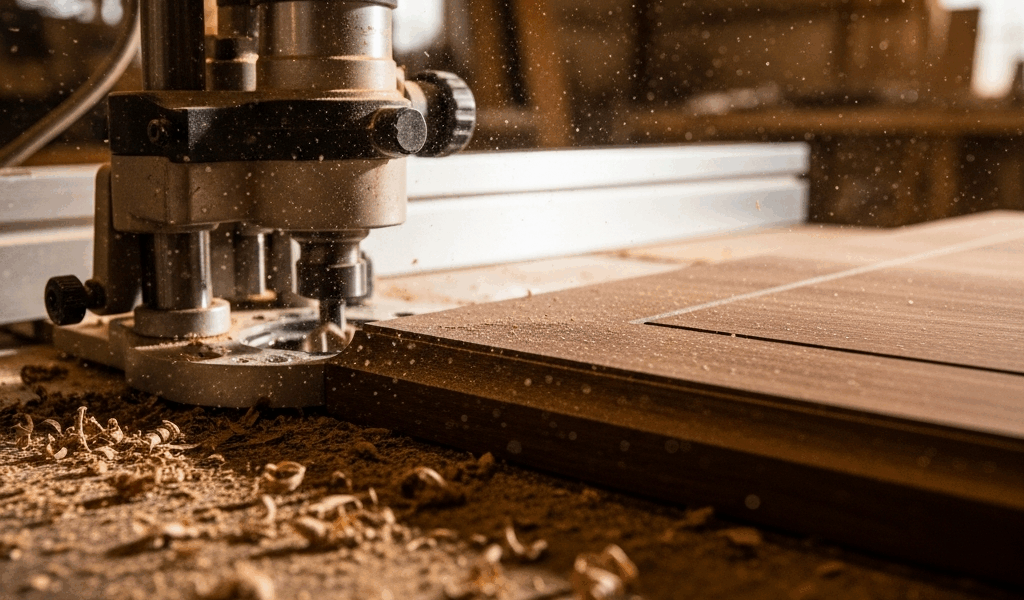
You want a router table and every review you have read starts listing products before answering the question that actually matters: do you need a benchtop that stores under your bench, a freestanding station that lives permanently in your shop, or a table saw wing extension that takes up zero additional floor space?
That form factor decision eliminates half the options before you even look at a price tag. And here is the insight most reviews bury at the bottom or skip entirely: the router you mount underneath matters more than the table you mount it in.
Benchtop vs Freestanding vs Table Saw Wing
Benchtop router tables clamp to your workbench or sit on top of it. They store against the wall or under the bench when not in use. Best for: shops under 200 square feet, woodworkers who use a router table occasionally (a few times a month), and anyone who cannot dedicate permanent floor space to another tool. Price range: $100–400.
Freestanding router tables are dedicated stations with legs, built-in dust collection ports, and typically better fence systems. They live permanently in your shop layout. Best for: shops with dedicated floor space, woodworkers who route daily or weekly, and anyone doing production runs where setup time and fence precision matter. Price range: $400–1,200.
Table saw wing extensions replace one wing of your contractor or cabinet table saw with a router table insert. Most space-efficient option — uses space that already exists. Best for: table saw owners with an available wing position who want routing capability without adding another footprint to the shop. Price range: $200–500 for the insert plate and fence system.
Answer this question first: how much floor space can you permanently give up? If the answer is “none,” you want a benchtop or a table saw wing. If you have a dedicated wall or corner, freestanding gives you the best working experience.
Best Benchtop Router Table Picks
Bosch RA1181 ($150–200). The most popular benchtop router table for good reason. Aluminum top stays flat, the fence is accurate enough for production work, and it accepts most router brands. The dust collection port actually works — it captures 80% of the chips when connected to a shop vacuum. This is the table I recommend to everyone who asks. It does not do anything fancy. It just works.
Kreg PRS2100 Precision Benchtop ($350+). The premium benchtop option. The fence system is the best in the benchtop category — micro-adjustable with a proper locking mechanism that does not drift. If fence accuracy is your priority (and for joinery work, it should be), this is the table to buy. The price is double the Bosch, and the fence is the reason.
MLCS 9561 ($100–130). The budget entry. Functional MDF top, basic fence, gets the job done for occasional use. The fence is the weak point — it flexes under heavy cuts and requires more attention to keep square. Acceptable for hobby work. Not the right choice if you are routing joints that need precision.
Best Freestanding Router Table Picks
JessEm Mast-R-Lift II with cabinet ($800–1,000+). The router lift alone is a revelation — you adjust bit height from above the table with a crank, no more reaching underneath and fumbling with the router base. The cabinet provides excellent dust collection when connected to a proper dust collector. This is the setup serious woodworkers graduate to and never look back.
Kreg PRS1045 Router Table System ($500–700). Complete freestanding system with Kreg’s precision fence, steel stand, and switch. Good dust collection integration. The fence is the star — same micro-adjustable design as their benchtop, but with longer rails for full-width board support. The table surface is MDF with laminate, which is flat and serviceable but not as durable as cast aluminum over years of use.
Rockler Pro Router Table ($400–600). Rockler’s house brand. Solid table with good fence and their own lift system. The advantage is Rockler’s accessory ecosystem — guards, featherboards, jigs — all designed to fit their table. If you shop at Rockler regularly, the compatibility is convenient.
The Router Matters More Than the Table
This is the buying insight that most reviews skip, and it is the most important thing I can tell you: a $100 benchtop table with a quality 2.25 HP router outperforms a $400 table with an underpowered $79 router. The table holds the router. The router does the work. Put your money where the cutting happens.
DeWalt DW618PK ($200–250). Fixed-base and plunge base combination kit. 2.25 HP motor handles any bit size without bogging. The fixed base works perfectly in a router table. This is the router I would pair with any benchtop table on this list.
Bosch 1617EVSPK ($200–250). The comparable option. Same 2.25 HP motor, same fixed/plunge combo kit, slightly different ergonomics. Both the DeWalt and Bosch are excellent table-mount routers. Pick whichever you find at a better price.
Avoid mounting a trim router (1 HP or less) in a table and expecting it to handle raised panel bits or heavy dado cuts. It will bog, chatter, and produce rough results. A full-size 2+ HP router is the minimum for serious table routing.
The Verdict by Shop Type
Occasional hobbyist, limited space: Bosch RA1181 + DeWalt DW618PK. Total investment around $400. Stores when not in use. Handles any routing task from edge profiles to box joints.
Dedicated furniture shop: JessEm or Kreg freestanding setup with a router lift. The above-table height adjustment transforms the routing workflow. Worth the $800+ investment if you use a router table weekly.
Limited space with a table saw: wing extension is the most space-efficient solution. Uses space your table saw already occupies. Look for cast aluminum insert plates for long-term flatness.
Precision joinery priority: Kreg PRS2100 benchtop with the micro-adjustable fence. The fence quality on this table exceeds some freestanding options at double the price. Pair it with a quality router and you have a joinery station that punches well above its price point.



Stay in the loop
Get the latest master wood crafters updates delivered to your inbox.