
Warped lumber has gotten complicated with all the YouTube advice and forum debates flying around. As someone who has flattened thousands of boards over two decades of furniture making, I learned everything there is to know about taming twisted, cupped, and bowed stock. Today, I will share it all with you.
That rough lumber you just hauled home from the dealer is probably twisted, cupped, bowed, or some combination of all three. This is not a defect. Wood moves as it dries, and rough boards sat in a lumber pile responding to humidity and temperature swings for months. Your job is to tame the distortion into flat, straight boards ready for joinery.
Assessing What You Are Working With

Place the board on a known-flat surface like your table saw top or a verified bench. Rock it to find the high spots. The pattern of rocking tells you what kind of distortion you are fighting.
Bow curves along the length. Cup curves across the width. Twist combines both, with opposite corners lifted. Most rough boards exhibit some combination of all three, which is why you need to identify each one before picking up a tool.
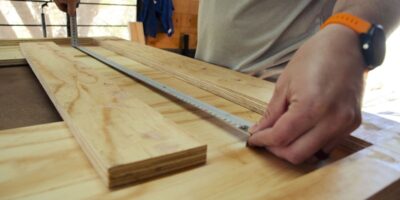
Measure the total distortion before doing anything else. A board that needs only an eighth-inch removed to become flat has plenty of thickness to spare. One requiring three-eighths might end up too thin for your project. I have made this mistake more than once — flattening a beautiful piece of walnut into something too thin for the table legs it was supposed to become.
Removing Twist First
Probably should have led with this section, honestly. Twist is the hardest distortion to deal with because it exists in two planes at the same time. You cannot simply flatten one face and expect the twist to vanish.
On the jointer, take very light passes and remove material only from the high diagonal corners. A twisted board rocks on those diagonal corners. Reduce them until all four corners contact the table simultaneously.
With hand planes, work diagonal strokes across the high corners. Check frequently with winding sticks, which are just two parallel sticks placed at each end of the board. When you sight across them and their top edges appear parallel, the twist is gone. I keep a dedicated pair of winding sticks with contrasting wood inlay on the edges so the misalignment shows up at a glance.
Flattening Cup
Cupped boards have a concave and a convex face. Place the concave side down on the jointer and take full-length passes until the entire surface contacts the bed. The cup gradually flattens as material comes off the high edges.
For severe cup, ripping the board into narrower strips, flattening each separately, and re-gluing actually wastes less material than trying to flatten the full-width board. Narrow boards cup less dramatically, so the total loss is reduced. That’s what makes this approach endearing to us woodworkers who hate wasting good lumber — you trade one wide board for a glued-up panel that uses more of the original thickness.
Straightening Bow
A bowed board curves along its length like a rocking chair runner. Place the concave side down on the jointer and take passes spanning the full length. Material comes off the ends first, gradually working toward the center until the entire face reads flat.
Severe bow eats substantial thickness. If your finished dimension is critical, check whether enough meat remains after straightening. Sometimes a bowed board is better cut into shorter pieces where the bow spans less distance and costs less material to remove.
Machine Sequence
Start at the jointer. Flatten one face completely, ignoring thickness for now. This becomes your reference face. Mark it with a cabinetmaker’s triangle so you never lose track of which surface is true.
Take that flattened face to the planer, riding it against the bed. The planer creates a parallel opposite face, but it cannot create flat on its own. It only copies whatever sits on the bed. This is why the jointer step cannot be skipped no matter how tempting it is to just run everything through the planer.
Hand Tool Alternative
Without machinery, start with a scrub plane for initial waste removal. The curved iron takes thick, aggressive shavings and quickly reduces high spots. Work diagonally across the grain in overlapping strokes.
Follow with a jack plane set for moderate cuts to level the scrub plane tracks. Then finish with a jointer plane, which uses its long sole to bridge low spots and cut only the highs. The length of that sole is the key — it averages the surface toward flat in a way shorter planes physically cannot.
Hand tool flattening takes longer but offers more control. You can target specific problem areas without affecting the whole board, and there is no thickness limit imposed by machine capacity. I flatten boards over 20 inches wide by hand because no planer in my shop handles that width.
Every piece of furniture starts with flat lumber. Rushing this step undermines all the careful joinery that follows. Take the time here and everything downstream becomes easier. Joints close cleanly, panels glue up without stress, and assemblies come together square because the stock was right from the beginning.

Stay in the loop
Get the latest master wood crafters updates delivered to your inbox.