Japanese wood joinery has gotten complicated with all the YouTube demonstrations, woodworking forum debates, and tool catalog marketing flying around. As someone who has spent years studying and cutting traditional Japanese joints alongside conventional Western joinery, I learned everything there is to know about where these techniques actually work in a modern shop. Today, I will share it all with you.
Western woodworking relies on glue and metal fasteners to hold things together. Japanese joinery rejects both entirely, achieving connections through precisely cut interlocking wood alone. These are not museum pieces or theoretical exercises for hand-tool purists. They are practical structural solutions refined over centuries to resist earthquakes, humidity swings, and the passage of time itself.
Philosophy of Fit

Japanese joinery demands perfection because there’s no adhesive hiding sloppy cuts. Every surface must mate precisely. Every angle must be exact. The joint derives its strength entirely from wood bearing against wood and the natural friction between perfectly mated surfaces.
This sounds impossibly demanding until you understand the approach. Japanese craftsmen don’t work to tolerances; they work to fit. Each piece is scribed from its mate, hand-cut to match, and adjusted until the union is complete. The process is slower but eliminates accumulated error.
Essential Joints
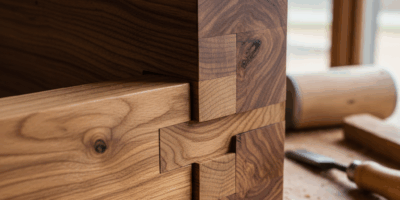
The nejiri arigata, or twisted dovetail, creates a mechanical lock in three dimensions. The tail twists as it enters the socket, making it impossible to withdraw without reversing the rotation. Once assembled, the joint cannot separate under any load direction.
The kanawa tsugi splices two beams end-to-end with interlocking fingers and wedges. This scarf joint transfers loads smoothly across the splice, allowing short timbers to function as continuous members. It’s the joint that made Japanese temple construction possible.
The shiguchi, or L-joint, uses blind tenons and precisely fitted rabbets to connect posts to beams. The geometry prevents any separation under compression or tension while remaining invisible from the exterior.
Tools of Precision
Japanese saws cut on the pull stroke, producing thinner kerfs with less effort. This matters because thinner kerfs mean less material removed and tighter joints. A 0.3mm kerf leaves more wood to work with than a 1mm kerf.
Japanese chisels are laminated with hard steel backed by soft iron. The hard steel holds a keen edge; the soft iron absorbs shock. These chisels pare end grain cleanly where Western chisels might tear.
The sumitsubo, a Japanese marking line, leaves a finer, more permanent mark than any Western chalk line. Accuracy begins with accurate marking.
The Fitting Process
Japanese craftsmen use carbon paper or persimmon tannin to mark high spots. The joint is assembled, pressure applied, then disassembled. Transfer marks show exactly where material needs removal. This cycle repeats until the entire surface makes contact.
Patience defines the process. A complex joint might require dozens of fitting iterations. Each iteration removes less material than the last as the fit approaches perfection. Rushing destroys the work.
Modern Applications
You don’t need to build temples to benefit from Japanese joinery principles. The attention to fit improves any woodworking. The mechanical joints inspire solutions for situations where glue might fail due to outdoor exposure or constant movement.
Start with simpler Japanese joints: the stub tenon, the half-blind rabbeted joint, or the basic dovetailed housing. These offer attainable entry points that teach the fitting philosophy without requiring years of practice.
Wood Selection
Japanese joinery traditionally uses hinoki (Japanese cypress) and sugi (Japanese cedar). These straight-grained softwoods cut cleanly and remain stable. Western cedar, Port Orford cedar, and basswood make reasonable substitutes for practice.
Avoid highly figured or interlocked grain for learning. The paring and fitting process becomes dramatically harder when the wood won’t cut predictably. Save the challenging lumber for after you’ve internalized the techniques.
Japanese joinery teaches what wood can do when respected and precisely worked. The joints themselves may take years to master, but the mindset improves your work immediately.


Stay in the loop
Get the latest master wood crafters updates delivered to your inbox.