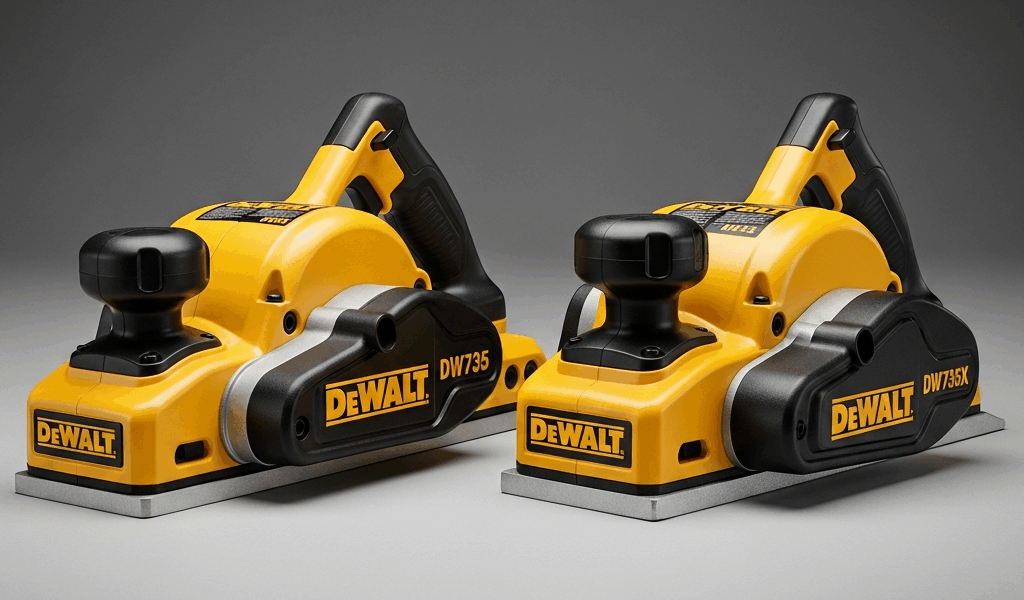
Short answer: the DW735 and DW735X use the same 13-inch, two-speed thickness planer. The “X” does not add power, capacity, or a different cutterhead. It is a package: the DW735X adds the DW7351 infeed/outfeed tables and a spare set of DW7352 reversible knives. Buy the X package when its price premium is lower than the current cost of those two accessories and you want both. Otherwise, buy the DW735.
DW735 vs DW735X at a glance
| Feature | DW735 | DW735X |
|---|---|---|
| Planer | DW735 | Same DW735 planer |
| Capacity | 13 inches | 13 inches |
| Motor | 15 amp, 20,000 motor RPM | Same |
| Cutterhead | Three knives, 10,000 RPM | Same |
| Finish settings | 96 or 179 cuts per inch | Same |
| Folding tables | Not in the standard package | DW7351 set included |
| Spare knives | Not in the standard package | DW7352 three-knife set included |
Retailer listings can change, so confirm the box contents and model number before ordering. Do not confuse cuts per inch with feed speed: DeWalt describes the two finish settings as 96 and 179 CPI. The cutterhead itself runs at 10,000 RPM; 20,000 RPM is the motor specification.
What the extra money actually buys
The DW735X normally bundles two useful accessories. The DW7351 consists of two folding tables and mounting hardware. They extend support at the entrance and exit of the planer, which is especially helpful with long boards. The DW7352 is a set of three M2 laminated-tool-steel knives. They are disposable, reversible knives with locator holes for alignment.
Neither accessory changes the planer’s motor or cutting capacity. The tables can make stock handling easier, but they do not guarantee snipe-free boards. Snipe can also be influenced by table alignment, board support, cut depth, workpiece condition, and technique. A spare knife set reduces downtime when the installed edges become dull or damaged; it does not make the initial cut better while stored on a shelf.
The simplest value test
Ignore a fixed dollar recommendation because tool and accessory prices fluctuate. Check the prices you can actually buy today and use this comparison:
DW735X premium = DW735X price − DW735 price
If that premium is less than the combined price of a DW7351 table set and a DW7352 knife set, the X package is the economical way to get both accessories. If the premium is higher—or you do not want both accessories—the base DW735 is the better purchase.
Choose the DW735X when:
- You want DeWalt’s folding tables immediately.
- You expect regular use and value having the correct spare knives ready.
- The bundle premium is below the accessories’ combined delivered price.
- You prefer one purchase and known-compatible parts.
Choose the DW735 when:
- You already own roller stands or have a long, level support surface.
- You use the planer occasionally and do not need spare knives yet.
- The base machine is discounted much more heavily than the X package.
- You want to choose a different support setup rather than the folding tables.
Performance is identical
Both packages use the DW735 planer. DeWalt specifies a 15-amp motor, a three-knife cutterhead turning at 10,000 RPM, and two settings that produce 96 or 179 cuts per inch. The fan-assisted chip-ejection system moves chips away from the cutterhead, while an automatic carriage lock is intended to reduce movement associated with snipe. The cast-aluminum base, material-removal gauge, thickness scale, and turret depth stop are also the same.
The two settings are useful for different stages of milling. The lower-CPI setting moves stock through with fewer cuts per inch and is suited to dimensioning; the higher-CPI setting leaves more cutter marks per inch for a finer final pass. Follow the manual’s limits and take lighter passes on wide or difficult stock rather than treating the motor rating as permission for an aggressive cut.
What neither package solves
A thickness planer makes the top face parallel to the face riding on its bed. It does not automatically flatten a twisted, bowed, or cupped board. Start with one flat reference face from a jointer or a properly constructed planer sled. Our guide to milling rough lumber explains the sequence.
The DW735X tables provide convenient support, but long boards may still need correctly positioned roller stands or a longer coplanar surface. Support the work without lifting it into the cutterhead. For surface defects, see the guide to reducing planer tearout on figured wood.
Knives and cutterhead upgrades
The factory setup uses three reversible knives. Each knife can be flipped to expose its second edge, then replaced with the proper set when both edges are spent. DeWalt identifies DW7352 as the replacement three-knife set.
Some third parties sell helical or segmented cutterheads, but that is a different decision from DW735 versus DW735X. DeWalt’s current manual says helical cutterheads have not been tested with this product and are not recommended. Consider installation difficulty, added cost, service implications, and manufacturer guidance before modifying the planer. If a cutterhead conversion is already your plan, the spare factory knives in the X package may have little value.
Setup and safety notes
- Secure the planer to a stable bench or stand; the machine is heavy and long stock creates leverage.
- Connect suitable chip collection. The fan-assisted exhaust ejects debris forcefully.
- Wear eye and hearing protection and keep hands away from the stock path.
- Disconnect power before changing knives, clearing a jam, or servicing the machine.
- Use only stock dimensions and cut depths allowed by the instruction manual.
- Check table alignment after installation; added tables should support stock without steering it upward or downward.
Verdict
There is no performance winner because the planer is the same. The DW735X is the better bundle when you want both the DW7351 tables and DW7352 spare knives and its premium is lower than buying them separately. The DW735 is the smarter buy when you already have material support, plan a different setup, or find the base machine at a substantially better price.
Compare exact model numbers, delivered prices, and listed box contents on the day you buy. That small calculation is more reliable than any permanent claim that one package is always the better deal.



Stay in the loop
Get the latest master wood crafters updates delivered to your inbox.