Best Paint Sprayer for Furniture — HVLP vs Airless for a Smooth Finish
Paint sprayers for furniture have gotten complicated with all the conflicting advice flying around. As someone who’s sprayed probably three hundred pieces of furniture over eight years — dining chairs, dressers, cabinets, the occasional ornate headboard that made me seriously question my life choices — I learned everything there is to know about what actually works. Twice I bought the wrong tool. The third time, I finally got it right. The number one mistake I watch woodworkers make is grabbing a sprayer built for walls and then wondering why their furniture looks like an orange peel. The tool matters. The type of sprayer matters even more.
This article includes affiliate links. We may earn a commission at no extra cost to you.
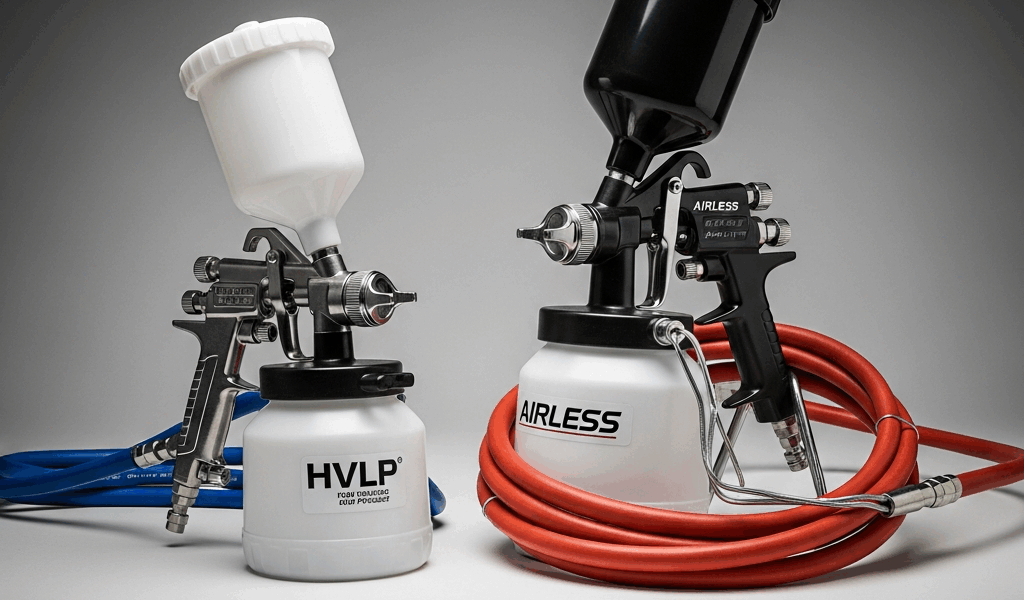
HVLP vs Airless for Furniture — The Short Answer
HVLP wins for furniture about 90% of the time. Full stop. Painting a dresser, a set of dining chairs, a side table, a cabinet — HVLP is your tool. But what is HVLP? In essence, it’s a system that atomizes paint using High Volume, Low Pressure airflow. But it’s much more than that. The low pressure means paint particles arrive at your surface finer and slower — which gives you two things furniture absolutely demands: a softer spray pattern that won’t blow wet paint off sharp edges and carved details, and dramatically less overspray bouncing back onto your work.
When I switched from an airless to a dedicated HVLP turbine unit about six years ago, I cut my finishing time in half. Not because the sprayer was faster — because I stopped spending an hour fixing runs and blowback on turned legs. That’s what makes HVLP endearing to us furniture finishers. It rewards patience and punishes shortcuts in a way that actually suits the work.
Airless sprayers force paint through a small tip at extreme pressure — often 2,000 to 3,000 PSI. Fantastic for painting a fence, an exterior wall, large flat cabinet boxes — anything where sheer coverage speed matters more than precision. I still own an airless. I grab it for production runs of flat cabinet doors or blasting the interior of a large wardrobe carcass where I need to lay down material fast. But for anything with curves, moldings, turned legs, routed profiles, or detail work? Airless will fight you at every pass.
High pressure creates overspray. Overspray bounces. Bounced paint lands on a surface you just sprayed, and now you’ve got texture. On a fence, nobody notices. On a painted nightstand meant to look lacquered — it’s the difference between a piece you’re proud of and one you sand back entirely and start over. Done both. Don’t make my mistake.
One honest caveat: airless does have an edge in one specific furniture scenario. Large, flat horizontal surfaces. Spraying a big farmhouse tabletop with waterborne polyurethane and wanting to lay down a thick, even coat fast — a fine-finish airless tip like a 210 or 310 can produce genuinely excellent results there. But that’s maybe 10% of the furniture work most woodworkers actually do. Everything else? HVLP.
Best HVLP Sprayers for Furniture Under $200
Probably should have opened with this section, honestly. Most people reading this have a budget and want a straight answer. Here it is: the two sprayers I recommend to woodworkers just starting to spray furniture — without spending professional money — are the Fuji Semi-PRO 2 and the Wagner FLEXiO 3500. They’re different enough that your choice between them really does depend on how serious you are about this.
Fuji Semi-PRO 2 — Around $175
The Fuji Semi-PRO 2 is a 2-stage turbine HVLP system. The turbine generates the airflow; you dial in fluid control with the needle adjustment on the gun. I bought my first one for $169 at a Woodcraft store on a Tuesday — used it almost exclusively for two years before I upgraded. It handles latex, chalk paint, milk paint, and waterborne polyurethane without complaint, though anything thicker than standard latex usually needs thinning by about 10%.
The T70 gun that ships with it is decent — pattern control is solid for this price range. Round pattern, fan pattern, switching between them takes maybe thirty seconds. The real limitation is that it’s a 2-stage turbine, so on heavy-bodied products you’ll feel it working. Chalk paint thinned to the right consistency sprays beautifully. Full-bodied latex primer? It’ll push through, but the motor lets you know it’s working.
What I like: consistent atomization, easy cleanup, the turbine unit doubles as a surprisingly decent dust collector in a pinch — though I’d advise against actually using it for that. What I don’t like: the hose is only 13 feet, which feels genuinely short when you’re walking around a large armoire, and the 400ml gravity-feed cup means you’re refilling more often than you’d like on bigger projects.
Wagner FLEXiO 3500 — Around $120
The Wagner FLEXiO 3500 is a different animal altogether. It’s a handheld turbine unit — turbine and gun are one piece — and the lower price reflects exactly that. I’ve used it extensively on smaller work: picture frames, decorative boxes, chair rails, a set of small floating shelves for a client’s kitchen. It performs well within its limits. The iSpray nozzle included with it is specifically designed for wider fan patterns on flat surfaces, and the Detail Finish nozzle is — honestly — genuinely excellent for fine work in tight spaces.
The tradeoff is weight. Holding a turbine in your hand gets tiring surprisingly fast — my arm was spent after about forty-five minutes spraying a set of four dining chairs. It’s also noticeably louder than a floor-unit turbine system. Overspray runs slightly higher than with the Fuji, though still dramatically better than any airless sprayer at this price.
Buy the FLEXiO 3500 if you’re doing occasional projects and want an all-in-one unit that stores in a small cabinet under your workbench. Buy the Fuji Semi-PRO 2 if furniture finishing is a regular part of your work and you want a more professional experience without the professional price tag.
Best HVLP Sprayers for Furniture Over $200
Frustrated by a particularly stubborn set of kitchen cabinet doors — the finish kept showing turbulence marks on flat center panels no matter what I adjusted — I ended up upgrading to a 5-stage turbine system. The improvement was immediate. Not subtle at all.
Fuji Q5 Platinum — Around $770
The Fuji Q5 Platinum is a 5-stage turbine HVLP system. Without exaggeration, it’s the sprayer I’d buy today if I were starting a small custom furniture finishing operation from scratch. The 5-stage turbine generates significantly more air volume than a 2-stage unit — atomization is finer, and you can spray thicker coatings like waterborne lacquers, conversion varnishes, even some oil-based products without heavy thinning to get there.
The T75G gravity-feed gun that ships with it has a non-bleed design — air stops flowing the moment you release the trigger. This matters more than it sounds. With a bleed-type gun, air keeps flowing between passes, stirring up shop dust that lands directly on your wet finish. I lost entire finishing sessions to this problem before I understood what was actually happening. Took me embarrassingly long to figure that one out.
The Q5 also runs quieter than lower-stage units. Not silent, but noticeably softer — if you spray indoors or in an attached garage, everyone in the house will notice the difference. Street price runs $749–$779 depending on where you buy. It’s an investment. It’s also a professional tool at a prosumer price, which is a harder combination to find than you’d think.
Earlex 5500 — Around $200
The Earlex 5500 sits right at that under/over $200 boundary — worth including because it’s one of the better values in furniture finishing, apparently overlooked by a lot of woodworkers who jump straight from entry-level to the Fuji Q5. It’s a 2-stage turbine like the Semi-PRO 2, but Earlex ships it with a noticeably higher-quality gun. The HV5500 gun has excellent fluid control and a clean spray pattern right out of the box — no fussing required.
I used an Earlex 5500 for about a year while my Fuji was being repaired and came away genuinely impressed with its consistency on waterborne topcoats. Milk paint over a chalk-painted dresser came out nearly perfect on the first pass. Same 13-foot hose limitation as the Semi-PRO 2, but the 1-liter cup is a real improvement over the Fuji’s 400ml. If the Q5 is out of budget and the Semi-PRO 2 feels too entry-level, the Earlex 5500 is probably the right move.
Spray Technique for a Glass-Smooth Finish
The best sprayer in the world will not save bad technique. I learned this spraying my first set of Shaker-style cabinet doors — ran the gun too slow, too close, and turned three coats of waterborne lacquer into a bumpy mess that took four hours of sanding to fix. A Tuesday afternoon I’d like to have back. Technique is everything.
Distance and Speed
For furniture finishing, keep 6 to 8 inches between the gun tip and the surface. That’s closer than most general painting guides suggest — closer distance means less atomized paint drying in the air before it hits, which means better flow-out and fewer dry-spray artifacts. Move the gun at a consistent speed — roughly 12 inches per second, which is faster than most beginners assume is right. Fast passes. Thin coats. That’s the whole game.
Overlapping Passes
Every pass should overlap the previous one by about 50% — spray the edge of your fan pattern over the center of the last pass. This sounds like it would build up heavy material fast, but because you’re moving quickly and laying thin coats, it evens out naturally. Inconsistent overlap is the cause of most streaky finishes I’ve diagnosed for other woodworkers. It’s almost always that.
Thinning Ratios
Almost every product needs thinning for HVLP. While you won’t need a chemistry degree to figure it out, you will need a handful of consistent ratios to start from. Here are the ones I use:
- Waterborne polyurethane (Minwax, General Finishes) — 10% water by volume
- Chalk paint (Annie Sloan, Rust-Oleum Chalked) — 15–20% water
- Milk paint (Real Milk Paint Co.) — mixed thinner than the manufacturer recommends, roughly 1:1.25 powder to water
- Waterborne lacquer (Target Coatings EM6000) — 5–10% water depending on temperature and humidity
- Oil-based polyurethane — 10% mineral spirits; swap to an oil-compatible cup and clean immediately after
The viscosity cup test is worth doing if you spray regularly — a #4 Ford cup runs about $20 on Amazon. Aim for a drain time of 20–30 seconds for most waterborne topcoats through HVLP. Drains in 12 seconds? Too thin — you’ll get sags. Takes 45 seconds? Thin it further or you’ll end up with orange peel. The cup removes the guesswork.
Sanding Between Coats
Sand between every single coat. Not optional — not even close to optional. First, you should sand with 320-grit after the initial coat to knock down dust nibs and raised grain, then 400-grit between every coat after that — at least if you want a finish that looks deliberate rather than accidental. I use a Mirka sanding block and a fresh tack cloth before every new coat. The sanding isn’t about removing material. It’s about creating a mechanical key for the next coat and eliminating any texture that’s quietly been building up.
Three thin coats sanded between each will outperform two thick coats every single time. Thin coats dry faster, sand easier, and don’t sag. Total dry film thickness ends up roughly similar — but surface quality is dramatically better. This is probably the lesson that took me longest to actually internalize. I still catch myself trying to shortcut it when a deadline is breathing down my neck. Don’t make my mistake.

Stay in the loop
Get the latest master wood crafters updates delivered to your inbox.