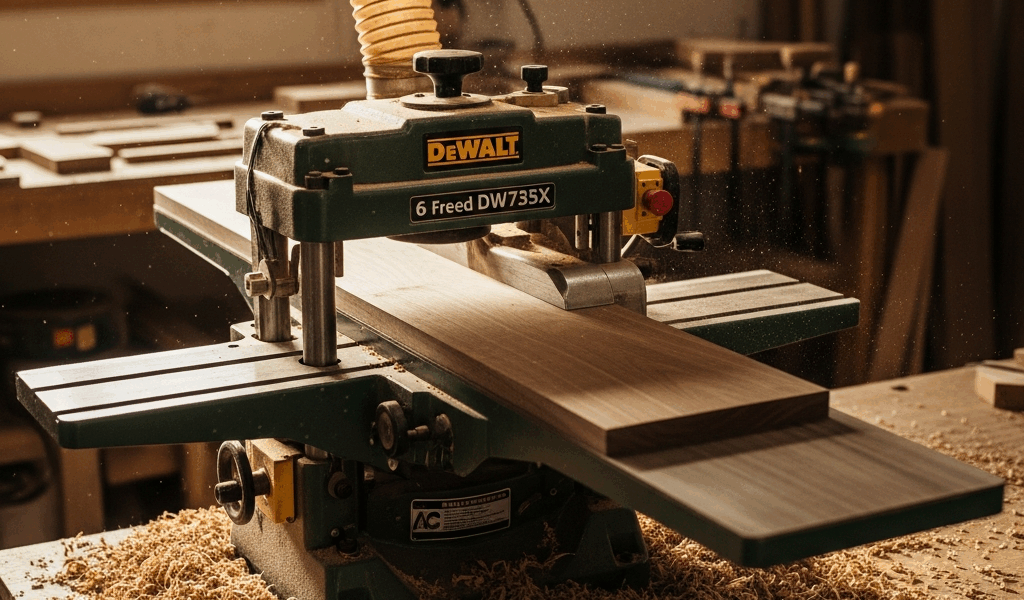
You are staring at a board that is 13/16 of an inch thick on one end and 7/8 on the other, and hand planing the whole thing sounds like a two-hour project you do not have time for. A benchtop planer solves that problem in about forty seconds. But before you drop $400 on one, there is a critical distinction most reviews skip entirely: a planer does not flatten boards. It makes them a consistent thickness.
This article includes affiliate links. We may earn a commission at no extra cost to you.
If that sentence just confused you, keep reading. The difference between a planer and a jointer is the most expensive misunderstanding in beginner woodworking.
What a Benchtop Planer Does (and What It Does NOT Do)
A planer mills stock to a consistent thickness. Feed in a board that is 7/8 inch thick, set the planer to 3/4, and it comes out exactly 3/4 inch thick across its entire length. Both faces will be smooth and parallel to each other.
What a planer does NOT do: flatten a cupped, twisted, or bowed board. If you run a cupped board through a planer, the feed rollers press the cup flat as the board enters, the cutter takes a pass, and the board springs back to its cupped shape when it exits — just thinner. You end up with a thinner cupped board. That is not helpful.
Flattening is a jointer’s job. A jointer creates one flat reference face. Then you run the board through the planer with the jointed face down to make the opposite face parallel and smooth. Jointer first, planer second. Without a jointer (or a router sled jig), the planer cannot give you a truly flat board from rough lumber.
Why this matters for buying decisions: if you only buy a planer without a jointer or flattening method, you are limited to working with lumber that is already reasonably flat — like pre-surfaced stock from the home center. If you want to work with rough-sawn lumber from a sawmill (which is cheaper and often better wood), you need both tools or a workaround.
Straight Knives vs Spiral (Helical) Cutterhead
Benchtop planers come with one of two cutterhead designs, and the difference is significant enough to affect which one you should buy.
Straight knives are two or three long blades that spin at high speed. They are loud — wear hearing protection, always — and they produce visible knife marks on the surface (fine ridges you sand or scrape out later). When the knives dull, you either flip them to the unused edge or replace them. Replacement knives cost $15–30 for a set. Machines with straight knives are less expensive.
Spiral (helical) cutterheads use rows of small square carbide inserts instead of long blades. They are meaningfully quieter — my shop neighbor can confirm — and they produce dramatically less tearout on figured wood like curly maple, flame cherry, and book-matched walnut. When an insert dulls, you rotate it 90 degrees to expose a fresh cutting edge. Four edges per insert means four times the usable life before replacement.
If you work with figured hardwoods regularly, the spiral cutterhead is worth paying for. The finish quality difference on a piece of curly maple is the difference between a surface ready for finish and a surface that needs twenty minutes of sanding to remove tearout. If you are primarily dimensioning construction lumber, soft pine, or straight-grained hardwoods, straight knives work fine and save you $200–400.
If you are considering DeWalt’s larger two-speed model, see our fact-checked DW735 vs DW735X package comparison; the machines are identical, but the included accessories differ.
nnTop Benchtop Planer Picks — 2026
DeWalt DW734 (13-inch, straight knives, $400–450). The default recommendation for good reason. Three-knife cutterhead produces a smoother finish than most two-knife competitors. 15-amp motor handles hardwoods without bogging. Material removal lock prevents accidental setting changes. This is the planer most woodworkers buy first, and most never feel the need to upgrade. Mine has been running for six years with one set of knife replacements.
Ridgid TP13002 (13-inch, straight knives, $350–400). The budget competition. Similar 15-amp motor and 13-inch capacity. The Ridgid lifetime warranty (with product registration) is the differentiator — if anything fails, Ridgid replaces it. Build quality is slightly below the DeWalt, but the warranty compensates. Good choice if long-term parts support matters more than initial fit and finish.
WEN 6552T (13-inch, straight knives, $300–350). The entry-level option. Adequate for occasional use on softwoods and straight-grained hardwoods. The two-knife cutterhead leaves more visible marks than the DeWalt’s three-knife design. Fine for a hobbyist who planes boards a few times a month. Not the right choice if you are milling hardwood furniture stock regularly.
Powermatic 15HH (15-inch, helical cutterhead, $800+). The step up for serious furniture makers. The helical head transforms the planer experience on figured wood — virtually no tearout on materials that destroy straight-knife planers. 15-inch width handles wider boards. The price is double the DeWalt, but if you are building furniture from premium hardwoods, the surface quality saves enough sanding time to justify the investment over a year of regular use.
Snipe — The Problem Every Review Should Explain
Every benchtop planer produces snipe — a slightly deeper cut in the first and last 2–3 inches of the board. It happens because the board is only supported by one feed roller (instead of both) at the beginning and end of the pass. This is not a defect. It is a design limitation of every benchtop planer on the market.
You will notice snipe the first time you run a board through your new planer and wonder whether you got a defective unit. You did not. Here is how to minimize it:
Use sacrificial boards. Place an 8–10 inch scrap board before and after your workpiece, feeding them in as a continuous train. The snipe occurs on the sacrificial boards instead of your project stock. This is the simplest and most effective solution.
Support long boards. Provide hand support at the outfeed end for boards longer than 3 feet. The board tipping downward as it exits causes more aggressive snipe. An outfeed roller stand costs $25 and eliminates this entirely.
Cut your stock 4–6 inches longer than final dimension. Plan for snipe when you dimension your rough lumber. Cut the sniped ends off after planing. This is standard practice in professional shops — nobody expects a benchtop planer to deliver a perfect surface end-to-end.
The Verdict
First benchtop planer for a home shop: DeWalt DW734. Best balance of quality, motor power, surface finish, and price. It handles everything from pine shelving to walnut table tops without complaint.Budget-conscious with warranty priority: Ridgid TP13002. The lifetime warranty is real and Ridgid honors it. If keeping costs down matters more than marginal finish quality, this is the smart buy.
Serious furniture maker working with figured hardwoods: save for the Powermatic 15HH or look for a used Laguna or Oliver with a helical head. The tearout reduction on curly maple, quartersawn oak, and figured walnut is worth every dollar if you are building furniture you want to be proud of.



Stay in the loop
Get the latest master wood crafters updates delivered to your inbox.